
AI has dramatically changed education. You know that.
We need to be concerned about AI and writing. How can we encourage students to develop as writers in a world where giving a quick prompt to a computer will generate an essay for them? We need to be concerned about AI and reading. How can we convince students to read a novel when BooksAI (BooksAI.com) can generate a great summary for them? How do we get them to compare and contrast two novels or two Shakespearean plays, when Google NotebookLM (https://notebooklm.google/) can do that for them? If I’m being cynical, why teach reading and writing at all? AI has leveled the playing field: great writers and weak writers can appear equal; strong readers and poor readers seem similar with AI’s help. Adults will be able to live fine lives without being able to read and write on their own, right? Panic about the impact of AI is justified.
In response to the panic, our approach to AI has been defensive. How can we block AI from doing students’ work for them? How can we design AI-proof assessments? How can we defend development of traditional reading and writing skills? These are fair questions, but I want to go in a different direction. Rather than figure out how to thwart AI, I want to focus on something AI can’t do. What skill can we give students that AI can’t replace?
What can’t AI do? It can’t take your place when you are asked to speak. Let’s look at some examples.
Some schools are moving to oral exams and having students defend their thesis in a conversation with their examiners with a side benefit of creating “a more conversational, extemporaneous style [which] will make higher education more interpersonal, more improvised and more idiosyncratic, restoring a sense of community to our institutions.” (https://www.nytimes.com/2025/08/26/opinion/culture/ai-chatgpt-college-cheating-medieval.html)
And after schooling ends? Situations such as this occur:
Thank you for your interest in our company. We’d like to know more about you, so we want you to respond to ten questions. Your answers will be recorded and viewed by our hiring committee.
The questions will be presented, and you’ll have 60 seconds to prepare a one-minute response. Longer responses will not be possible because the next question will appear.
Make sure your camera and microphone are enabled.
When you are ready, click on the link below.
That is step one in the hiring process for a major travel tour operator. If passed, step two is a Zoom meeting with many listeners evaluating how the candidate speaks. Note that the company is primarily interested in how well prospective employees communicate verbally. Of course, right? Tour guides must speak well. A unique situation. Or is it?
I talked to the owner of several restaurants in California. When he advertises for help, he doesn’t accept resumes. He only accepts short videos of applicants explaining why they are interested in the job and what unique skills they can offer to make the restaurant successful. Not all of his employees have customer-facing jobs, but he insists he can learn enough about every applicant from a five-minute video to know if he wants them in his restaurants in any capacity. Even a line cook needs to be a good oral communicator.
Oral communication is equally critical when you get the job. Think of how much speaking is involved in your average day. What percent of your day is spent talking? Perhaps you used AI to generate objectives for the unit, but what makes the lesson valuable is the way you present it. Who do you want on your team at Back to School Night? Who do you want with you when an angry parent comes in for a meeting? Someone who communicates well, right? What percent of your day is spent listening to others talk? Who in your building do love listening to? The better speakers have more impact in meetings and on school culture. How many situations can you think of right now when strong oral communication skills are needed?
Speaking is by far the #1 language art, yet we almost always overlook its importance. And in an AI world, excellent verbal communication skills are the way to set yourself apart. Teach students how to be well spoken and they will have a voice that cannot be replaced. So how do we teach speaking?
Speaking skill can be divided into two distinct parts: what needs to be done before we speak and what needs to be done as we speak. All speaking involves these parts: one to one, small group, large group; formal and informal; in-person or digital. Before we speak, we think about the audience, we create content, we design aids, we dress for the occasion. AI can help us before we speak, but be cautious. Generic content from AI won’t match your specific audience’s needs. Visual aids suggested may reflect the errors that almost everyone makes with PowerPoint slides, for example, such as overused bullet points, too much text, and silly graphics.
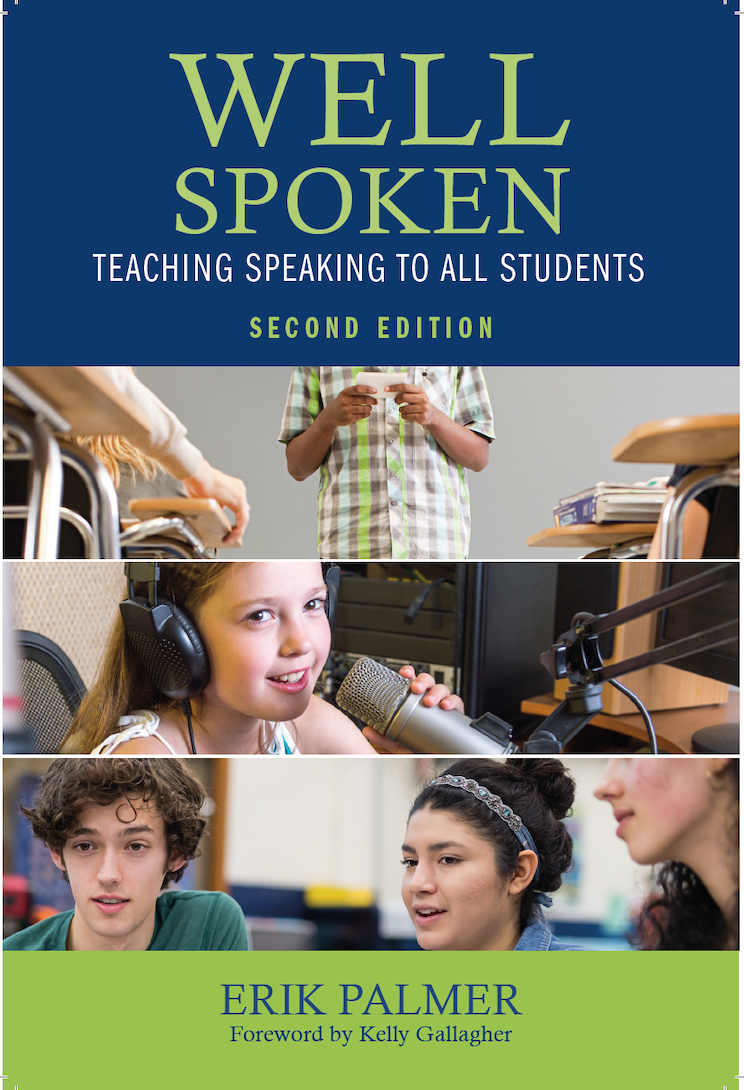
But once the talk or presentation has been created, AI is worthless. It’s the skill of the speaker that matters. What do good speakers do? They are poised and free of annoying tics that distract. They have voices that make every word easy to hear. They have lots of life in their voices so listeners can hear appropriate emotions. They make eye contact. They use their hands, face, and body to gesture to add emphasis to their words. The adjust pace for impact by speeding up to create excitement or slowing down for emphasis. [Adapted from Well Spoken: Teaching Speaking to All Students]
Do you have lessons to teach these skills? Likely not, yet they are all easily teachable. For example, if you want to teach adding life to a talk, post a phrase such as this:
I can’t believe you did that.
Ask students to change the meaning by changing the life in the voice.
I can’t believe you did that. (I thought someone else might but not you.)
I can’t believe you did that. (I expected you to do something else.)
I can’t believe you did that. (I’m upset with you.)
Students now see the value of adding life. Post a small speech where adding life will make an impact:
We were lost. The storm was raging, lightning was flashing all around us, thunder was crashing, and rain was coming down in buckets. My sister lost it.
“We’re doomed! We’re going to die out here! Help!”
Challenge students to say those words with feeling. Ask each speaker to raise the bar by adding even more than the last one. They begin to see how developing this skill is important for engagement…and fun.
Finally, ask students to add feeling to a talk like this one (generated with ChatGPT help):
There are health risks from vaping. Most vapes contain nicotine which is highly addictive. Vaping can affect brain development. It can cause lung inflammation. Vapor may contain formaldehyde, heavy metals, and other cancer-causing substances.
You know how students would read this before your lesson on life because you have heard many, many dull book reports and presentations of other types. But after this simple lesson, you’ll be amazed. Where would you add life to make these facts stand out?
Students don’t master adding life from one lesson just as they don’t master any other skill instantly. But now they are on the path to becoming interesting, dynamic speakers. There are lessons to teach all the other skills of performance, too. Your students will stand out during the discussion and doing the presentation, and, of course later in life, filming the interview or speaking at the staff meeting. AI can’t do that.
https://www.routledge.com/Well-Spoken-Teaching-Speaking-to-All-Students/Palmer/p/book/9781032757575

 The PVLEGS Blog