
Can Numbers Be Biased?

We love statistics. Specifically, we love raw number statistics: number of students proficient or advanced, number of babies named Emma, number of hot dogs eaten in 10 minutes, and more. We also love percentage statistics: grades; batting averages in baseball, women’s pay as a percentage of men’s pay, and so on. There is a certainty to these. Statistics are made of numbers, and numbers don’t lie.

But while numbers don’t lie, it is easy to use the statistics compiled from them in a biased way. Election seasons are full of examples of this point. The media literate person needs to understand how statistics can be manipulated—and that’s where statistics literacy comes in. Let me offer a hypothetical example—followed by tips for educators and parents to teach students about statistics literacy in either the classroom or at home.

Hypothetical Example: I want my students to turn off all devices for one day—24 hours with no cellphone, no computer, no e-reader, no Xbox, no anything. I want them to see how addicted they are and how life can still continue without screen time. Let’s say I try this experiment with 100 students in three of my middle school classes. I toss out the idea on Monday and ask students on Tuesday how many succeeded. The answer? Only one. I spend some time Tuesday sharing some numbers with students about the average amount of screen time spent daily and the possible negative effects that may have. I repeat the challenge. On Wednesday, five students report that they turned off all devices for a day.

Bias in Selection

Let’s look at two reports using statistics from Tuesday and Wednesday:

The No Device Challenge is gaining traction. In only one day, five times as many students as the day before accepted the challenge. At this rate, in just two more days no students will have devices on.

The No Device Challenge is not gaining traction. After two days, 95% of students have failed to change their behavior.

Both reports are true. Both accurately report the numbers, and the statistics are correct. Yet they lead to opposite conclusions about how the project is going. The reporters selected different numbers to analyze. If you are biased in favor of this project, you will likely use the first report. If you are biased against this project, you will likely use the second.

Sneaking in Biased Words

Beware of descriptive adjectives added to statistical reports. Numbers are embedded in sentences and paragraphs, and the words used to introduce the numbers suggest bias:

The No Device Challenge is gaining traction. In only one day, an impressive five times as many students as the day before accepted the challenge.

The No Device Challenge is not gaining traction. After two days, a disappointing 95% of students have failed to change their behavior.

It is extremely common to see opinions such as these slipped into statistical reporting. Just one or two words can totally influence the way you read the numbers. Did the number of students surge up to five, or did the number of students barely budge from Day 1?

Bias in Graphs

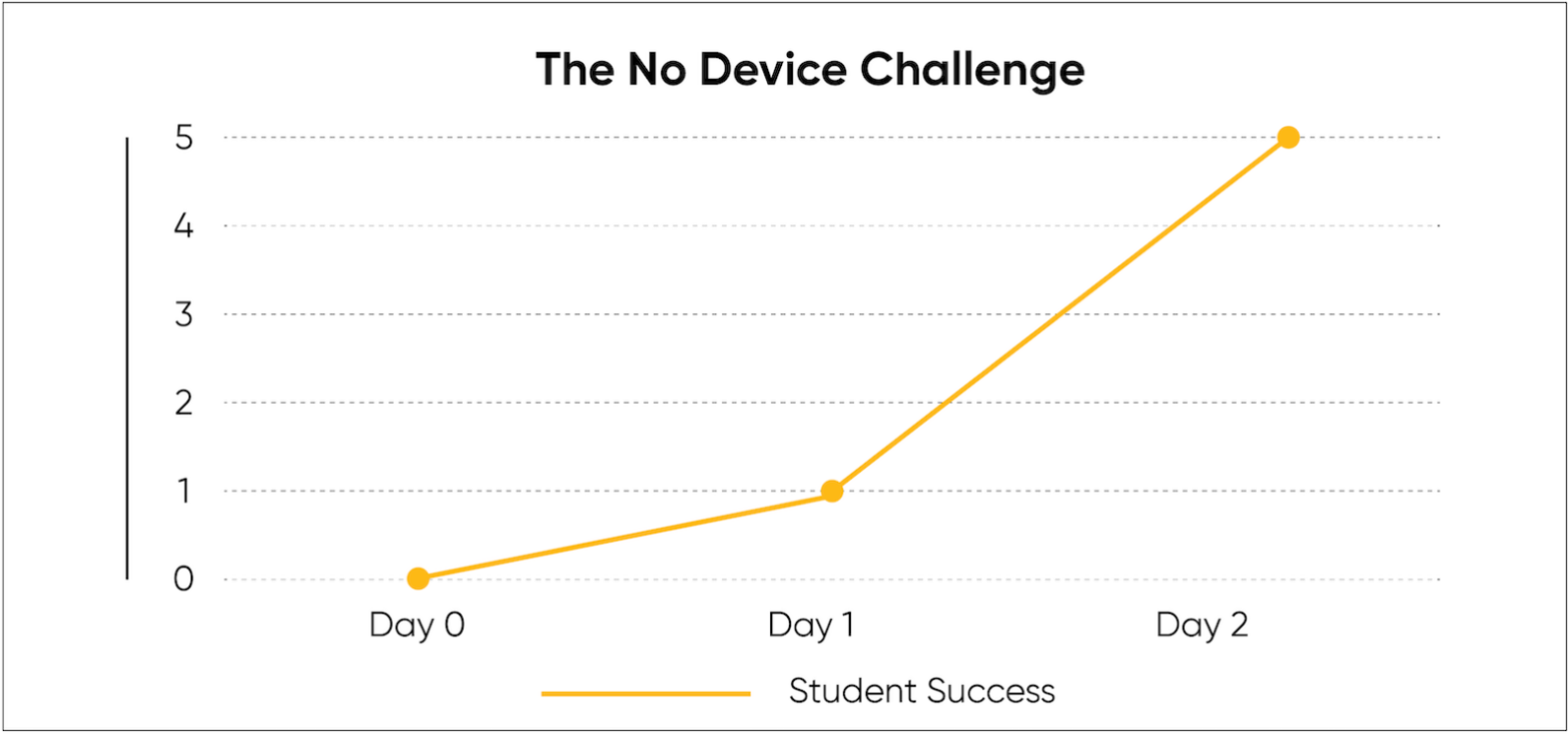
Graphs are used in biased ways, too. Here’s a graph that makes the No Device project look great:

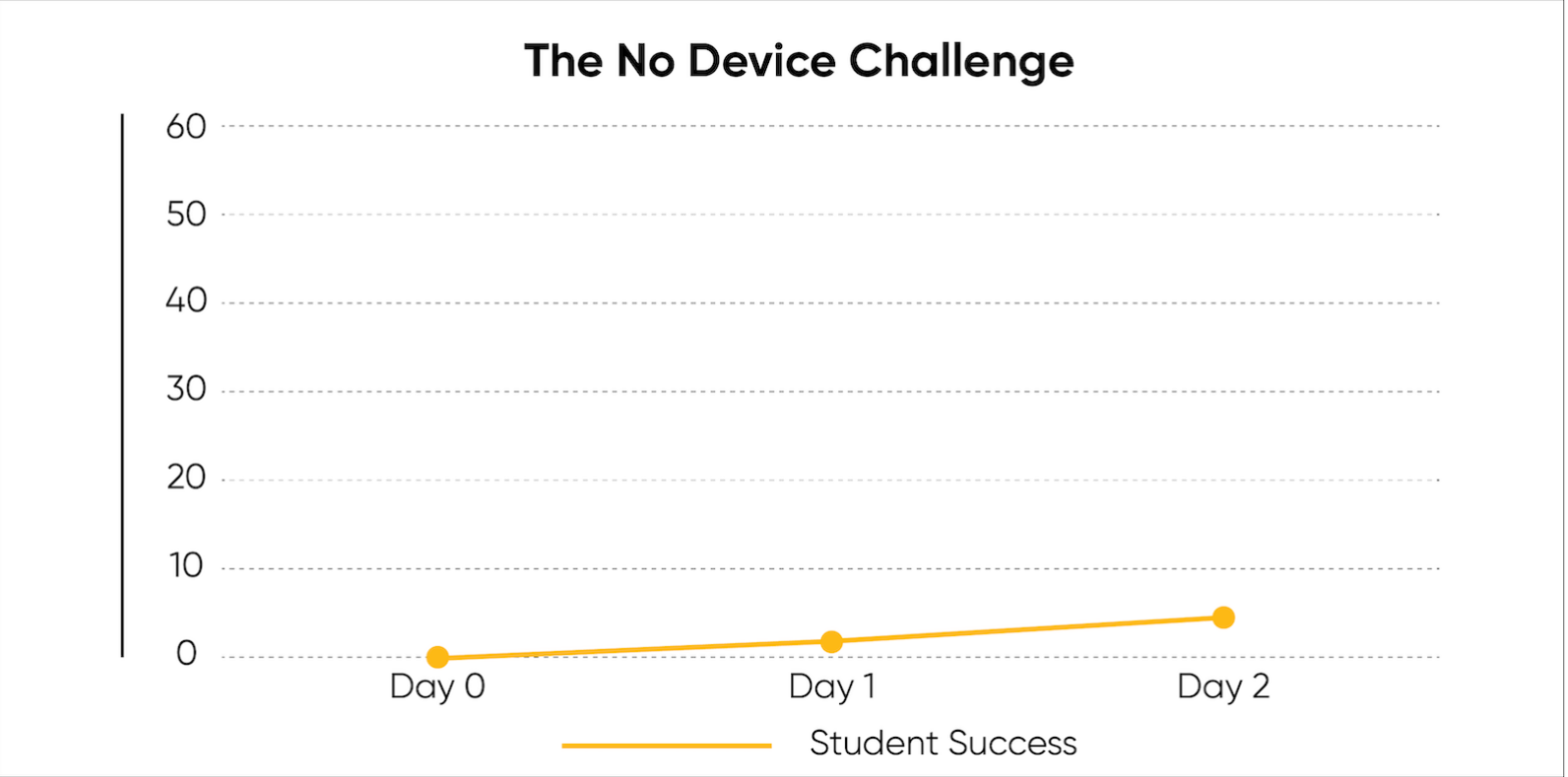
But if you change the graph to include all of the students, the project is going nowhere:

Again, both charts are accurate. They use the same numbers, but somehow, they leave different impressions. Changing the scale is a very common way to make the mundane seem dramatic.

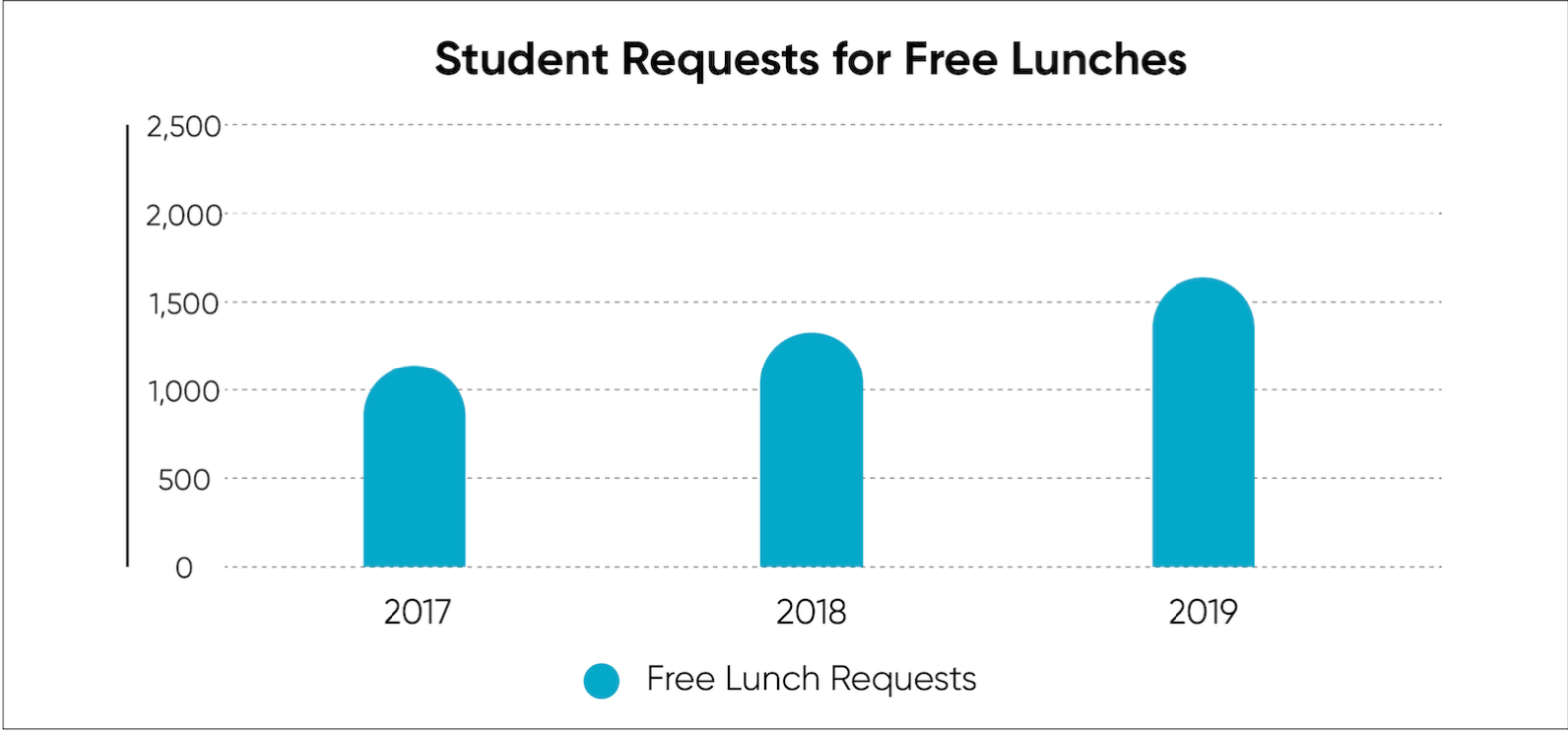
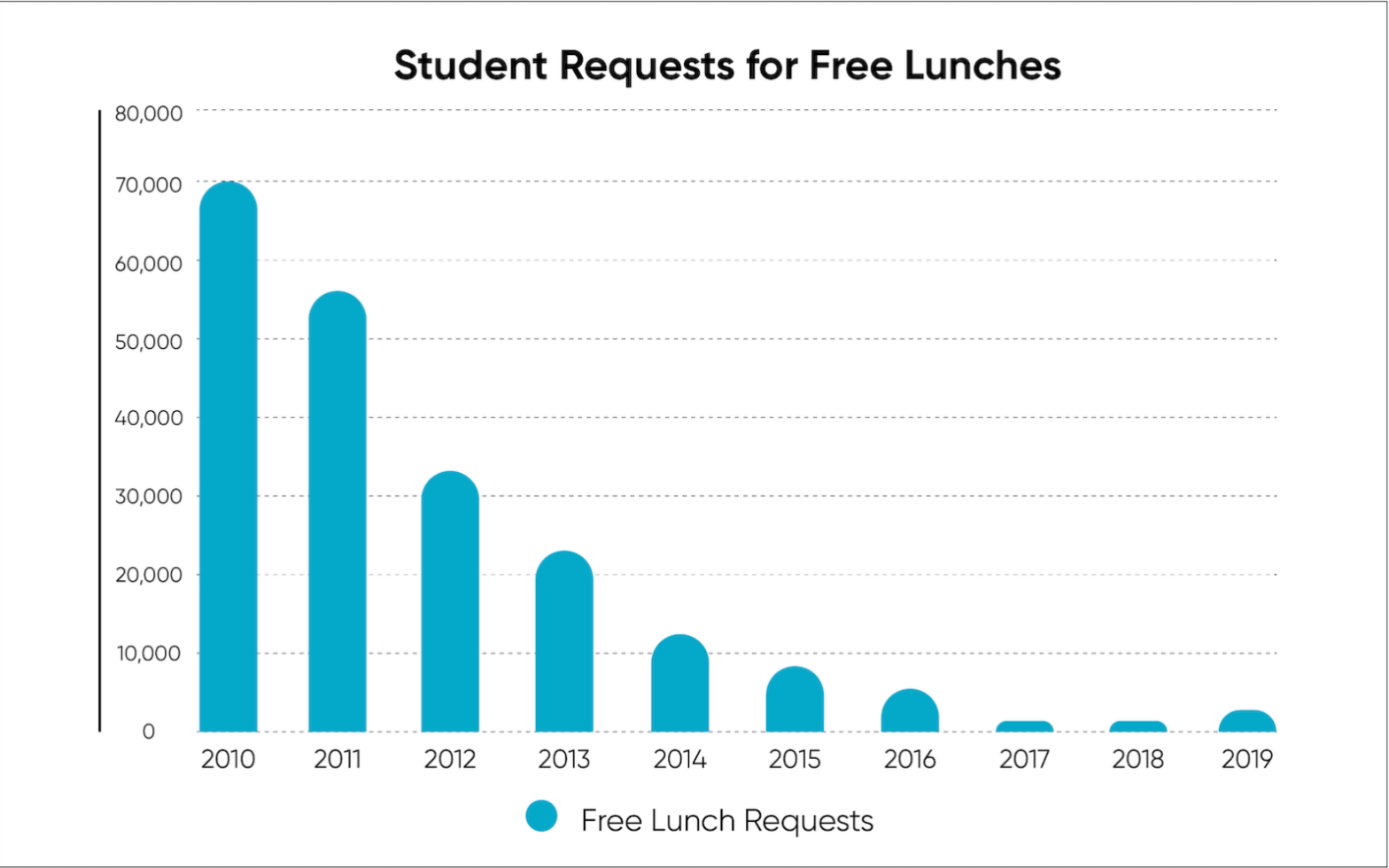
Selecting only a piece of a graph can change the impression, too. I made up these numbers, but let’s say this is a graph of students who need free lunches. This looks scary, right? Our community is falling apart!

How about looking at the entire graph?

The numbers didn’t change, but somehow the community doesn’t look as bad, does it? It looks like lots of progress has been made.

Bias in Percentages

There was a 200% increase in snow days last year in my district. If I had said, “Last year we had one snow day and this year we had two,” you wouldn’t have been impressed, but it is another way of describing what happened. What if I said that last year, about 1% of the days during the school year were snow days? Again, it comes down to which numbers you select to compare. Do you want to be dramatic and shock readers? Make a percentage with one snow day and two snow days. 200%! Do you want to keep things calm? Make a percentage with two snow days and 185 days in the school calendar. 1%. Both are true. Both are biased.

The Bottom Line: Statistics don’t lie. But that doesn’t mean that they can’t be manipulated. The perceived certainty of numbers can make us less critical than we need to be when reading the barrage of figures that come our way daily.

Tips for Teachers

  • Make sure students know that it is possible to be biased and true. Reporters don’t have to lie about the numbers; they just choose the ones they want to use.
  • Have students look for adjectives that describe the numbers. We read “a shocking 15% increase” differently than “a modest 15% increase.” Bias shows up in those adjectives.
  • Encourage students to look for the bigger picture. In an era where the dramatic is used to attract eyeballs, perspective is lost. “One million people may be in trouble!” Is one million a big number? There are 7.7 billion people on the planet, so one million is way less than 1% of the population: about one one-hundredth of 1% (0.01%).
  • Have students look for different ways to put numbers together. For example, in my No Device activity, there was a 500% increase (from 1 to 5), there was five-fold increase (from 1 to 5), there was an increase of four percentage points (from 1% of the students to 5% of the students), there was a 95% failure rate, there were 19 times as many students failing as succeeding (95 divided by 5), and so on. Have them discuss how the different versions suggest different meanings.
  • Tell students to analyze all graphs. Is this the right scale to use? Is this a representative selection? What other graphs could be made with the same numbers?

***

Blog contributor Erik Palmer is an author of the HMH Into Reading and HMH Into Literature programs. Palmer was also a guest on HMH’s Learning Moments podcast, Shaping the Future: Future Skills for Fact-Checking Online Fakes.

Posted in Uncategorized | Leave a comment

Giving Little Kids Voice

Speaking Activities for Early Elementary School Students

In a previous post, we looked at speaking activities for middle and high school students (https://www.hmhco.com/blog/public-speaking-activities-middle-high-school-students). I noted that there are many speaking activity suggestions available online for teachers who want to encourage oral communication for students. Many activities, though, seemed designed for older students. It is not likely that kindergartners will participate in a Socratic Seminar or that first graders will compete in debate. Because of this, when I suggest that all teachers need to teach all students the specific skills needed to become confident, competent speakers, there can be a tendency to think, “Yes, but that applies to older students only.” That is a mistake. Very young students need guidance and can vastly improve as speakers if we don’t sell them short, so to speak.

How many times do we ask early elementary students to speak? I watched a kindergarten teacher lead Weekly Share Time. She had students pass around a teddy bear while her eyes were closed, and when she said, “Stop,” the person holding the bear said something about what they did over the weekend: “My grampa and me got ice cream and then we went to the store to get a spray for some bugs in his basement.” In 1st grade, I watched students read aloud. In 2nd grade, a teacher in the elementary school where I taught had students do research about countries and do a presentation for the class: “Here is my map of Italy. The population is 59 million. Famous people are…” How many different ways do you ask students to speak in your class? From day one in elementary school, oral communication activities occur. And as I said in the previous post, if you looked at all those activities with new eyes, you would notice that every one of them is about making students talk, but none is about how to teach students to talk well. We excuse young students for presenting poorly. After all, they are little kids. We can’t expect them to be good speakers. I strongly disagree, and I will share a link to a video that shows what students can do.

Treat speaking as you do writing

When do we begin teaching writing? When students walk in the door. Here’s how to make letters; these are fragments and run-ons; here’s where commas go; this is when to capitalize; paragraphs have topic sentences; and so many more. Specific lessons about all the pieces of good writing. So, when should we begin to teach speaking? When students walk in the door. Here’s how to make sure your voice is heard; this is what eye contact is; here’s how to make descriptive hand gestures; this is where to add excitement in your voice; and so on. The resource below gives an idea of the specific skills needed to speak well and points in the direction of lessons we need to teach. From the previous post:

Assign speaking activities differently: Choose an activity that emphasizes a particular skill that good speakers demonstrate; teach lessons about that skill in advance of the activity; have students speak.

Let me share three ideas for developing key skills that will fit any early elementary class and can be scaled for upper elementary grades, too.

Birthday interview: Voice

Often, teachers tell students to speak loudly. That’s bad advice. Good speakers do not yell at the audience. They simply have voices that allow all listeners to hear every word. Their voices are just right for the space. Sometimes we speak more softly than other times, but we make sure that even when whispering, everyone can hear what we are saying. Tell students that they need to make sure that everyone listening can hear each word without struggling. They don’t need to be loud, but of course some students may need to be louder than might feel comfortable with at first. (And some need to tone it down!) On the student’s birthday, invite him to come up to the “stage” for the interview. One kindergarten teacher in my school used a pencil as a microphone. You may have something more fun to represent the microphone.

Teacher: [holding the ‘mic’] Today we are talking to Kim. Hello, Kim. How old are you today? [holding the mic in front of Kim]

Kim: Six

Teacher: Class, would you please raise your hand if you didn’t hear Kim? [a few hands go up] Kim, could you repeat that so everyone can hear?

Kim: Six.

Teacher: Excellent. Six years old. Wow. What is your favorite food to eat?

Kim: My favorite food [a couple of hands go up—Kim notices] My favorite food is pizza.

Teacher: Do you like pepperoni, mushrooms?

Kim: I hate mushrooms. I like cheese pizza but sometimes ham. My mom likes mushrooms but I pick them off.

Teacher: I hear you like soccer. Tell us about that.

Kim: I’m really good at soccer. My team won…

After a few interviews, students get the idea, and it becomes rare to have to comment about voice.

Favorite toy: Gestures

We all know that gestures are part of engaging an audience, and we give students points on speaking rubrics for gestures. Sadly, we don’t teach lessons about how to gesture well. Tell students that hand and body gestures contribute to understanding and keep audiences interested in the talk. Very few teachers keep their hands still while talking to students so ask students to notice the gestures you are using as you talk to them. Tell them that they will be giving a talk about their favorite toy and the focus will be on gestures. Ask five students to bring in their toy Monday, five others on Tuesday, and so on. At showtime, guide them in gestures as they speak.

Teacher: Sofia, what did you bring in today?

Sofia: I have my mermaid doll.

Teacher: How pretty! Hold her up so everyone can see. Nice. I’m not sure this side of the room can see so let’s show them, too. Fine. Now what’s her name and what is a mermaid?

Sofia: She’s Pixie. Mermaids are girls who live in the water.

Teacher: Does she have legs?

Sofia: She has a tail.

Teacher: Like a dog’s tail?

Sofia: No, like a fish.

Teacher: Can you show the class her tail? [Sofia points] Oh, nice gesture! We can see exactly where to look. What else would you like to point out? Tell us all about her.

Sofia: One of her eyes fell out but my mom put a new one in here. [showing the face to the class, pointing to the new eye] I got her for my birthday when I was one. I like to play with her hair and put ribbons in and this crown. [holding the crown up] If you push this button [points], her tail lights up.

With this safe, fun activity, students get used to using their hands and bodies as they speak. Starting with these simple moves, it will be easy in later grades to transition to gestures for emphasis or descriptiveness.   

Read aloud: Life

Many students animated when talking in the lunchroom but become monotonous when put in front of the class. Rather than teach students about inflection, an unfriendly word for little kids, teach them about adding “life.” Indeed, this is a critical lesson in order for students to advance as readers. Students move from sounding out to fluency to prosody—understanding how the text is supposed to sound. Show them a bit of text where the author has given readers clues about how the text should be “heard.” For example, use a page from Children Make Terrible Pets. On one page, this line appears:

“OH. MY. GOSH. You are the cutest critter in the WHOLE forest!”

Teacher: The author uses big letters for the first three words. That means he wants us to say those words a certain way. Let’s all read those first three words aloud together.

Class: Oh my gosh.

Teacher: Hmm, that sounded pretty regular. I think he used big letters because he wants big life in our voices. Let’s try again.

Class: [some shouting] OH MY GOSH!!

Teacher: Wonderful! Did you notice he put periods between the words? Periods tell us to stop, right? Now how should we read this?

Class: OH [pause] MY [pause] GOSH!!

Teacher: Wow, that was great! Now who wants to volunteer to read the next sentence? Think about that word in big letters and how we might add life to that sentence. Gigi?

Gigi: Youarethecutestcritterinthe [shouting] WHOLE forest.

Teacher: We’re getting the idea! Every time we read, let’s read like a speaker with lots of life in the voice. We’ll use the clues the author gives us.

There are many places in all the books we read where adding life makes the story come alive and makes listeners love reading. Read aloud becomes much more interesting.

Video proof

If you want to see what kindergarten students are capable of, watch the video posted by a teacher who used a green screen for weather “reports” after her unit about weather. https://youtu.be/-qy3JMkhOQM

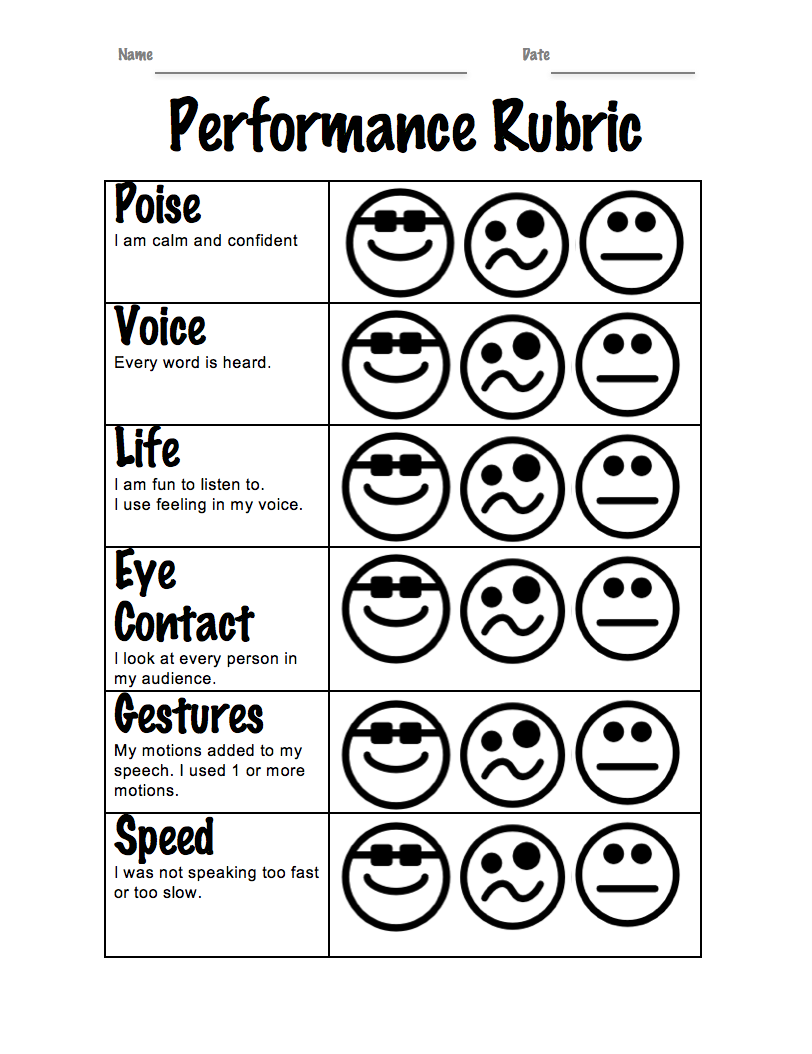
The students aren’t all masters of speaking and not all are comfortable yet. It is clear, however, that the teacher taught about gestures, poise, voice, and more. The students are on the right track and would get high marks using the checklist below.

Posted in Uncategorized | Leave a comment

Better Student Podcasts…Way Better

Most student podcasts are pretty poor. We taught students how to use the tool but didn’t teach them the speaking skills needed to be impressive when using the tool.

Read this post I wrote for Houghton Mifflin Harcourt to learn how to move student podcasts from mediocre to impressive: https://www.hmhco.com/blog/how-to-start-a-student-podcast

Posted in Uncategorized | Leave a comment

But what about the introverts?

I get this question a lot when I do workshops. In my presentations, I point out that speaking well will benefit all students for their entire lives; I share a framework that makes the complex art of oral communication simple and understandable; I show specific lessons to teach all students how to be better verbal communicators; and I make it practical and easy to teach every child to speak well. But there are non-believers, and the questions come up:

What about introverts?

 What about students who hate public speaking?

 What about kids who refuse to do it?

  What about kids who can’t speak in front of classmates?

   What about…

Let me answer all of these questions. I’ll look at five different ways.

  1. Do not sell students short.

How many times do you normally quit on children? Do you fail to teach math to a child for whom you think math is difficult? Do you tell some child, “Nah, don’t do this writing assignment. I don’t think you can do it.”? Do you fail to expect good outcomes and therefore stop helping some children? If you do, please quit teaching. Let’s not be naïve: some kids are better at some things than others. Some kids have an easier time reading or doing math or drawing or singing or coding or whatever than other kids do. But our job is help every child make progress. It is no different with speaking. Some kids love to talk, some are good at talking (those two do not always go together!), and some kids do not love to talk. Oh well. I will help all of them master the number one language art, speaking.

  1. Introversion is not a disabling condition.

Have you read Quiet by Susan Cain? You should. It will cause you to rethink some of the things you do. If Cain is correct, at least one-third of us are introverts. She is, and I know I am. And yet I now speak for a living. Huh? Lacking a propensity for something is not the same lacking the ability to do that thing. And introversion is not the same as social anxiety, a highly curable condition. Cain wrote about that here.

In 21 years of teaching, I have taught about 3,000 students. Using Cain’s number, about 1,000 of my students were introverts. Of that 1,000, how many failed to do the speaking I asked of them? Zero. None. Nada. Zip. How many of them failed to improve as speakers? Zero. Did I have students that needed extra encouragement? Yep. Students who needed a little hand-holding? Yep. Students who needed a little extra help and practice? Yep. The math teacher on my team had extra sessions to help struggling students. Shouldn’t a teacher asking kids to speak do the same sort of thing? Of course. What kind of teacher doesn’t give extra help to kids who need it?

  1. Don’t believe the hype.

I really wanted to label this section “Don’t believe the bull#@*^.” I know the story: “Public speaking is the number one fear of adults.” It isn’t. Fear of public speaking showed up often when folks were asked to make a list of the ten things they feared, but not one of you would say, “Burn me badly! I’d prefer that to speaking in front of a group!” But the bad rap remains, so when a child says, “I fear speaking!” many teachers are tempted to say, “You poor baby! Me, too! We all hate speaking!! Don’t worry, I’ll protect you! I won’t make you do that horrible thing!”

Nonsense.

As I mentioned, some kids hate math. Many adults say, “I was never good at math!” So do you excuse students from math? Don’t let a child’s professed fear/dislike become an excuse for non-participation. Part of the problem is the phrase “public speaking.” Don’t teach “public speaking,” teach speaking. (See this article.) I teach kids how to speak well in any situation. I want good discussion comments. I want well-spoken questions. I want good peer-editing conversations. If you make speaking a valued part of your class, speaking loses its scariness. It’s just another version of what we always do.

Screen Shot 2021-06-06 at 9.00.13 AM

  1. Don’t cheat any child out of an important life skill.

Like it or not, verbal communication is the number one language art. We speak far more often than we read or write. Professionally and socially, speaking well increases odds of success. Students will have to interview for a job, explain the app to an investor, talk about the graphic design portfolio, talk to a client about the landscaping proposal or investment plan, and on and on. Why wouldn’t you want to help children in a low-stakes, we-are-all-just-learning-here environment like your classroom? Yep, you hate this, but you’ll hate it much more if you don’t have the skills you want when it really counts.

  1. We fear what we don’t know.

Years ago, I was asked by a friend if I wanted to go for a ride in his plane, a two-seater, single-propeller Piper Cub. I said, “Sure,” but we were just off the ground when I had a small panic attack. What if something happened to him? A heart attack, for instance. Panic! Why? Because I don’t know how to fly a plane. If I knew, I wouldn’t have panicked: something happened to Steve but I can get this thing down.

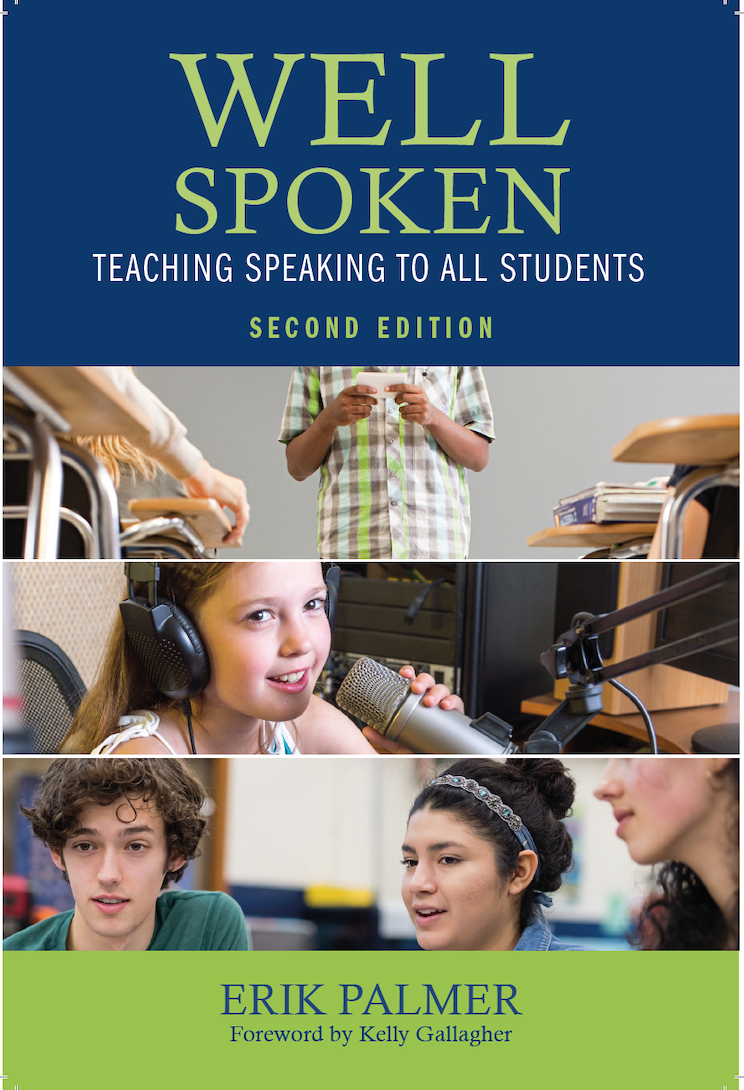
The largest part of students’ fear is because they don’t know how to fly. Every year, teachers have made them talk, but never has a teacher taught them how to do it. You know it’s true: you have a haiku unit, but you do not have a speaking unit. Students get lessons about comma usage before being asked to write an essay, but never get a lesson about how to add life to their voices. Students get lessons about parts of a cell, but never get lessons about parts of a well-built visual aid. I wrote Well Spoken: Teaching Speaking to All Students (goo.gl/dgoSS7) to solve this problem. It has a simple, practical framework for understanding and teaching speaking. You will find that once students know exactly what they are supposed to do, they can do it. Visit pvlegs.com.

Bonus—Give students a digital voice first.

We live in an era with many, many digital tools for oral communication. That means that mastering oral communication is even more important than ever. It also means there are many ways to practice, get feedback, and develop confidence for eventual in-person talks. Every device can record audio and video now. Students can record, re-record, and re-record until they get something they like. In the fall, I’ll let students submit a digital talk to be played in class. By spring, they are ready to speak in person. I ask the students that didn’t participate in the live, classroom discussion today to think about what they want to say and record their comment to be played tomorrow. I love Flip. Learn about it here. Again, students can re-record as needed and the fun of the digital tool and the fun of seeing others can inspire participation.

Bonus two–Mike Rowe has a great story about someone afraid to speak:

http://mikerowe.com/2016/05/twihi-breakingsilence/ 

Bonus three–This book could by yours for free. Contact me at pvlegs.com to see how to get a copy.

Screen Shot 2024-05-21 at 9.24.47 AM


Posted in Speaking | 1 Comment

Listening skills: Way More Than “What’s the main idea?”

HMH listening

I sometimes get emails from an organization about improving student listening skills. They point out that speaking and listening are not being addressed in schools and claim that listening is a key piece of the “literacy puzzle.”

Kudos to educators who focus on these forgotten language arts! For years, English teachers have been focused only on “reading and writing.” If you look at conferences, Twitter feeds, and educators’ blogs, you will see “reading and writing” so many times that it will seem as if we ought to just adopt a new word: readinganwriting. You never see “reading, writing, and speaking” or “reading, writing, speaking, and listening.” This reveals an enormous blind spot.

The most critical language arts—the ones upon which almost all learning depend—are ignored. Are all students competent listeners? Isn’t it apparent to all educators that students generally do not speak particularly well? Yet no one seems to think that we ought to start paying attention to these language arts. We seem to not realize that speaking and listening are teachable, too.

The organization suggests playing audio clips of interesting news stories for your students and then asking comprehension questions about the stories. If I use a story I heard on National Public Radio about how China is no longer buying plastic waste from the U.S., for example, and ask online comprehension questions, I wonder if that is sufficient. Does listening to the news teach listening skills? What do my questions really measure? Is this a test of comprehension skills, checking to see if students understand what a main idea is? While the main idea may be “China has stopped buying our discarded plastic,” a child may report that container ships arrived in the United States from China with goods made in China and, instead of going back empty, were being filled with plastic. The student listened well but had difficulty with the concept of main idea. Is this a memory test? A question such as, “What reasons did they give for why China doesn’t buy plastic anymore?” may assess remembering more than listening.

Putting those issues aside for a moment, notice all the elements of listening that were never asked about:

  • The story had a little music at the start as the reporter introduced himself. Did you notice it? Is the music important? Why do you think the music was added? What does music contribute to a story?
  • At one point, some sound effect was playing as the speaker was talking. What was that noise? Did you realize it was noise from a recycling plant? Did you hear glass tinkling? Did you hear the conveyor belt running? Why do you think they added that sound? Does it help you understand the story?
  • How well does the reporter speak? Was his voice clear? Did he have feeling and emotion in his voice? Is there a certain style of talking that news people have? Is that the way you speak?
  • Sometimes the reporter played a clip of other people speaking. Did hearing the voice of the recycling plant manager add to the story? Did hearing the voice of the environmental scientist affect your understanding of the problem? If the reporter had just told you what they said instead of playing a recording of their voices, would it have made any difference?
  • How well did the plant manager and the scientist speak? Did they have different styles from each other and from the reporter? Who was your favorite to listen to? Why? What makes someone fun to listen to?

We don’t have to be media literacy experts to think of these questions. We simply need to realize that good listeners should be able to do much more than repeat what someone said. Because messages come with sounds and music attached, listeners should be asked to think about the audio elements of messages. Because speaking skills can dramatically affect the way we receive messages, listeners should be able to identify the skills needed to be an effective speaker and to critique the speakers they hear. If we fail to teach students how to listen to all the elements of what they hear, we risk creating passive consumers of media instead of astute, active thinkers about media.

Bottom line: It’s time to broaden our ideas of listening. If we really want to improve listening skills, we need to listen to much more than words. https://erikpalmerconsulting.com/

Screen Shot 2024-05-21 at 9.24.47 AM

Posted in Media Literacy, Speaking | Leave a comment

Instead of an essay

“What does democracy mean to you?”

That was the writing prompt I gave to my class. I was expecting a three-paragraph essay about the rights, duties, and responsibilities of citizens. Ryan asked if he could make a video. Of course, video creation is not on the Big Test. We do lots of writing so I was not worried about test prep, and I’m open to letting kids make choices. I don’t know much about how to make a video, though, so I asked, “Do I have to teach how to make a video?”

“No, I already know how.”

I said OK.

Here’s what I knew about Ryan. He was an odd duck. He was tired of writing. Often as teachers, we focus on what we love, and English teachers love reading and writing. In fact, if you look at NCTE materials, conferences, and blogs, you’ll see “reading and writing” so many times that you’ll begin to think we should just make them one word, readinganwriting. You never see “reading, writing, and speaking” though speaking is by far the number one language art. This is an enormous blind spot. We pretend that we “cover” speaking skills because we have students talk during writing and reading activities, but we never focus on teaching speaking skills.

We all know that the fear of public speaking exists. What we miss is that some kids hate writing but love speaking.

Ryan was one of those. He would much rather say what he thinks than write what he thinks. Had I forced him to write, he would have dutifully and quickly slapped some words on a page and turned them in. As it turned out, he spent hours crafting an animated video showcasing his spoken words. His take on democracy was wildly different than I expected, but brilliant. I never would have gotten his perspective without letting him speak his response. He would have turned in a “template” writing, fulfilling the requirements without any heart. Only through oral communication could he express himself fully. You can see his video here: https://youtu.be/0_TJBfL5gzs

I realized that I had many students like Ryan, students that had wonderful things to say. And I also realized that many tools exist to showcase oral communication via podcast, video, and audio recording. I opened the door to speaking by giving digital oral communication options for activities, and many kids came charging through that door. This also opened the door to teaching speaking rather than assigning verbal activities. But that is a post for another day.

Posted in Uncategorized | Leave a comment

Why Student Presentations Bore Classmates

cropped-book-cover

“In New Jersey v. TLO, the Supreme Court granted certiorari to consider the appropriateness of the application of the exclusionary rule.  The Court overturned the lower court ruling in a 7-2 decision and held that the search did not violate the Fourth Amendment.”

What does that mean?  I heard that during a student presentation about landmark Supreme Court cases.  I can’t challenge the accuracy of the statement because that is exactly what the Court did.  I can challenge the appropriateness of the statement for the listeners.  Most eighth graders are probably not familiar with “certiorari” (though if all students are researching Supreme Court cases, the listeners in that situation may be) and probably no eighth graders understand what the exclusionary rule is.  What we have here is an example of a student presenting information without any consideration of the audience.  It happens all the time in our classrooms.

Here is what happened in the situation above: the teacher gave each student a case to research; she gave them a date for an oral presentation; she required certain content (name of the case, decision of the case, law the case was based upon); and she gave them a score sheet that would be used to evaluate the presentation which included eye contact, time limit, and posture. In this case, the student got maximum marks.  He accomplished what was asked.  Unfortunately, the class got nothing from his presentation.  The teacher failed to require that the speech be designed for the audience, a common omission.

All oral communication must be designed for a particular audience.  This is true for one-on-one communication, small group communication, or large group communication.  It amazes me how often speakers miss this point and fail to analyze the audience.  I recall being called to a faculty meeting on Friday afternoon so someone from the district could introduce us to RTI with a PowerPoint presentation full of densely packed text.  Really?  Is that going to work with this audience at this time?   You have been to talks where the speaker failed to understand the audience, too: telling you things you already knew; using insider jargon audience members didn’t know; not noticing the mood of the listeners; and so on.  If adults can be so inept at designing a speech for a specific group, no wonder children fail as well.  Students need specific instruction about how to build a talk for an audience.

First, whenever an assignment is given that involves talking to an audience (this includes mock interviews, discussions, book chats, digital stories, podcasts—everything!), begin with an explicit caution to students to think about the audience and design the talk for them.

You may have read a book designed for boy readers, but our class has boys and girls.  How can you make the book talk interesting to all of us?

We will have an in-class discussion about whether or not we should ___________.  Come prepared to state your opinion and defend your position on the issue.  Think about what arguments will be persuasive to class members.

You researched your topic and know a lot about it.  We didn’t research it and our class may not know many of the terms you are now familiar with.  How can you explain to our age group the important things we need to know?

Ideally, at some point the audience will change.  Perhaps students will present to another grade level or to parents.  This creates a great opportunity to broaden the discussion and analyze disparate audiences.

Second, make sure students know they will be judged in part based on how well they communicated with the audience.  The audience must be involved in scoring this part.  Way too often, students speak at the teacher only.  They know he or she is the only one whose opinion counts.  This is misguided.  A speech is for an audience and only by asking the audience will we know if the speech was effective.

Let’s score Spencer’s speech.  Did you think he did a good job of designing his talk for you?  Did he make everything understandable?  Did he keep you interested?  We use a 1 to 5 scale, remember, with 5 being perfect.  Raise your hand if you give Spencer a five?  A four?  A three?  Hmm, seems like most people gave you a three, which is good but which could be better.  What did you think he could do better next time, class?  (Discuss)

It does not damage students to have their performance scored if the teacher creates the proper atmosphere. (Of course, we don’t all get perfect marks, we are just beginning to master the difficult job of presenting…)  It does damage students to fail to teach them that what the audience thinks matters.

Third, teach students how to connect with the audience.  A good talk becomes a great talk if specific statements are added that let the audience know the talk was designed just for them.  The speaker must take his topic and connect it to the lives of the listeners.  In the eighth grade class mentioned above, this would be a connector:

How many of you have cell phones?  Would you be OK with the principal taking your phone and looking at your text messages?  My case, New Jersey v. TLO, is about a principal searching a student’s stuff, too, and like you, she wasn’t happy about it.

Now, some old Supreme Court case is much more interesting to the class.

Students (and adults!) need to do a better job of making sure they design their words for their listeners.  That means that we have to do a better job of letting them know how to do so. https://erikpalmerconsulting.com/

Posted in Speaking | Leave a comment

Teaching Speaking, the Forgotten Language Art

What are the skills involved in effective oral communication?

Nobody exactly knows. This is what I find out when I ask teachers the question. We all have some ideas, but no one knows for sure what is really involved.

It’s an important question. In every classroom at every grade level in every subject, students are asked to speak: book reports, discussions, showing solutions, debates, reading aloud, presenting lab results, research reports… And as digital tools enter the classroom and students engage in digital storytelling, podcasting, Zooming, and video production, speaking skills are on display like never before. By this point in the year, the odds are excellent that you have already had some kind of student presentation.

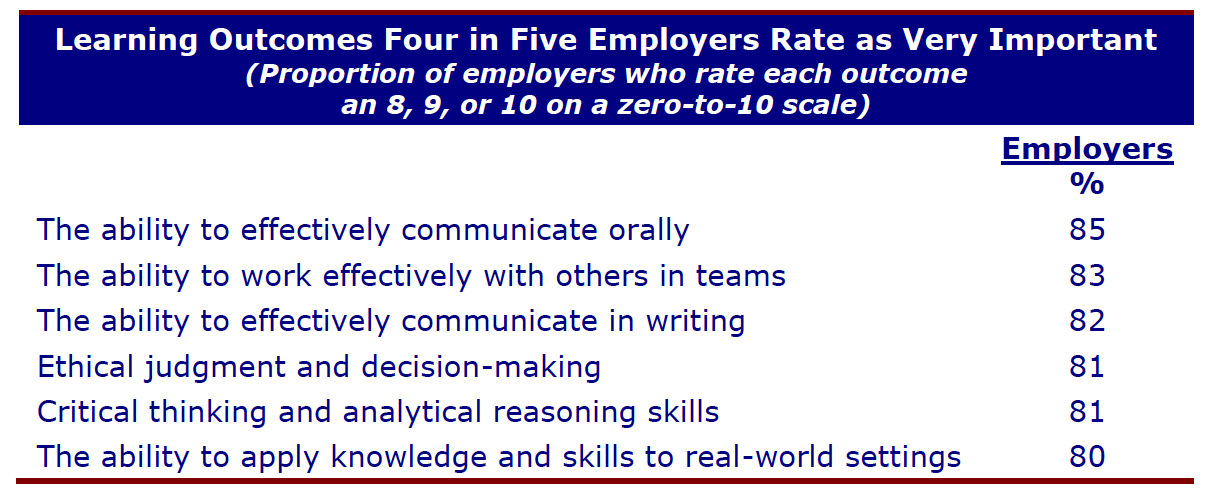
And in life beyond the classroom, oral communication is the most important language art. I am, as you may have guessed from other posts I’ve written, obsessed with skills that will be important for our students in their lives after school. With the tools out there today, oral communication is more important than ever. It is always at or near the top of skills employers are looking for.

I don’t care what job students ultimately get—people who speak well will be more successful at the job than people who don’t speak well.

But we don’t exactly know the secret to effective speaking. I am not referring only to “public speaking” which is what we tend to think of: the big presentation to large groups. The interview, the staff meeting, the sales call, the Back to School Night show, the wedding toast, the Socratic Seminar, the Zoom meeting, and more all require the exact same skills of oral communication.

There has been an enormous blind spot in education and specifically English and Language Arts classrooms. Organizations such as ReadWriteThink indicate the problem. Reading and writing only? Adults use those language arts far less than speaking. Oral communication is overwhelmingly the way we communicate, yet few people feel confident and competent as speakers.

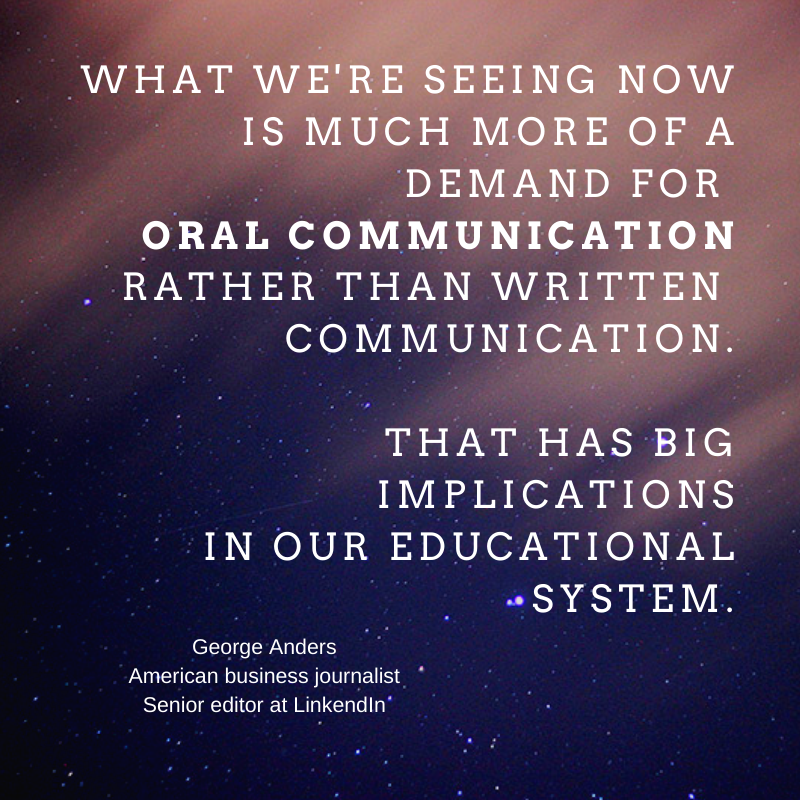
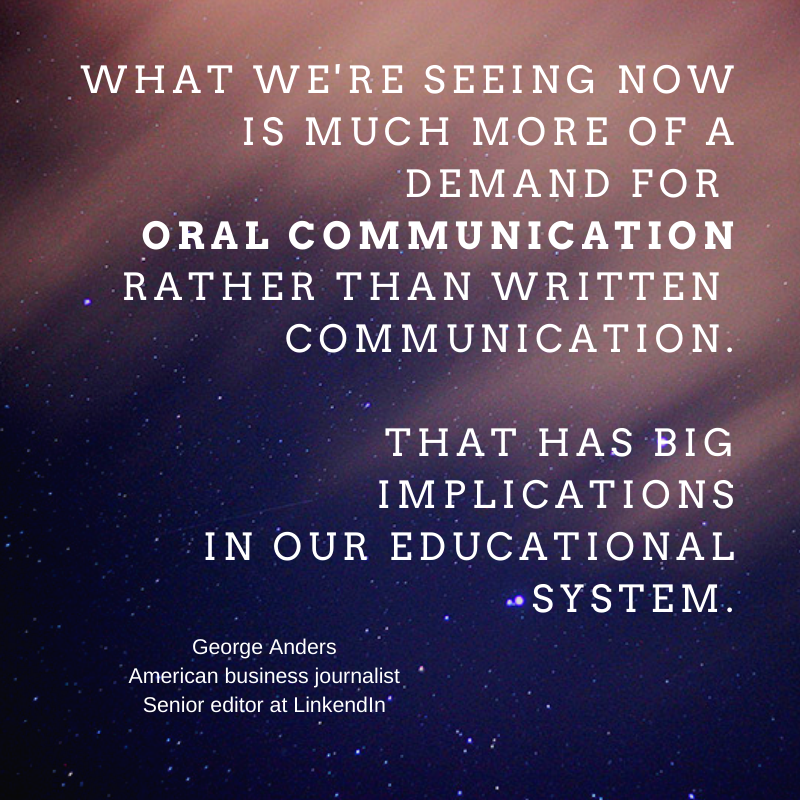
What we're seeing now is much more of a demand forThe non-stop focus on readinganwriting–the words are so commonly put together that they might as well be blended–fails to give students real voice. I understand that you love reading novels and writing poetry, but your students need to be taught how to be effective speakers. It is not an innate ability and requires direct instruction.

Let me give you an example of the problem. I have collected many rubrics/score sheets over the years and there is nothing close to agreement.From a 9thgrade “Science in the News” assignment: 5 points each for “make eye contact,” “speak loud enough,” “hold head up,” “use note cards,” “knowledgeable;” 20 points for “five W’s answered.”

From a 4thgrade “Historical Fiction Book Share:” 10 points each for “interesting opening and satisfying conclusion,” “speak loudly & slowly,” “make eye contact,” “preparation and practice are evident;” 15 points for “presentation is organized;” 5 points for “keep audience engaged;” 20 points for “the character is creatively shown.”

From a 10thgrade “Cultures of the Ancient World:” “Oral Presentation: 20 points—Organized; Good eye-contact, loud voice; Dressed in clothes that symbolize the era.”

From a district language arts committee generic rubric:

4) Speaks fluently (i.e. with expression, volume, pace, appropriate gestures, etc.) with varying formality for a variety of purposes using appropriate vocabulary, correct sentences organization, and respect with distinction;

3) Speaks fluently (i.e. with expression, volume, pace, appropriate gestures, etc.) with varying formality for a variety of purposes using appropriate vocabulary, correct sentences organization, and respect;

2) Partially speaks fluently…”

Well, you get the idea. We all seem to think that eye contact and a loud voice are important, but would a student know what it takes to be effective based on these score sheets?  In an educational career from K through 12thgrades, a student will never see the same scoring system more than once. There is no common language, no common understanding. And I love the “etc.” of the generic rubric, the universal way of saying, “I bet there’s more, but I have no idea what.” We are telling students, “You guys know all the secrets to speaking fluently, don’t you? Expression, volume, pace, gestures and all that other stuff.” But they don’t know! And much more importantly, has any teacher taught even one lesson about any of those elements? For example, one lesson about pace and why it’s important and how to adjust it, followed by little practice speeches/activities?

So we are stuck listening to students who say, “I’m like all for like health care and all but I’m like whoa who is gonna pay and stuff, you know what I mean?”  At least we are stuck until we make two changes: one, become clear on what it takes to be an effective speaker; two, commit to teaching oral communication skills more purposefully before you assign the speaking activities you already have.

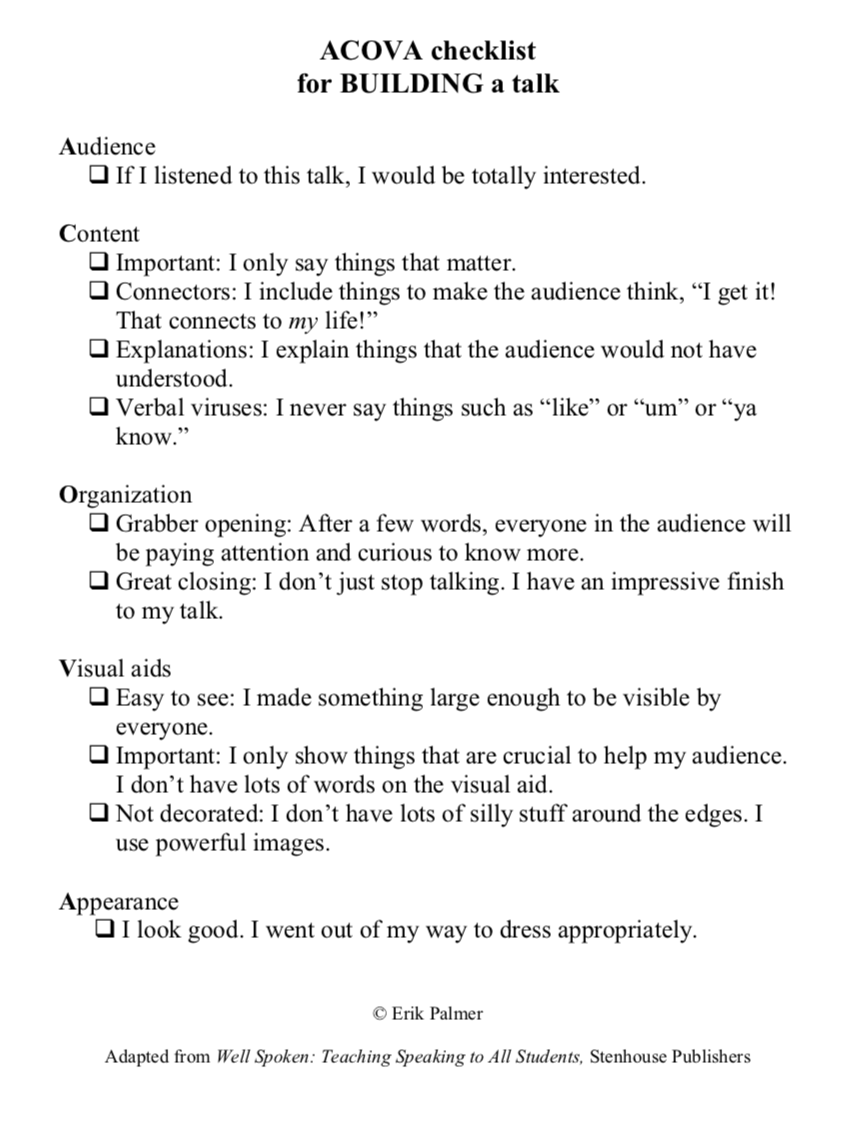
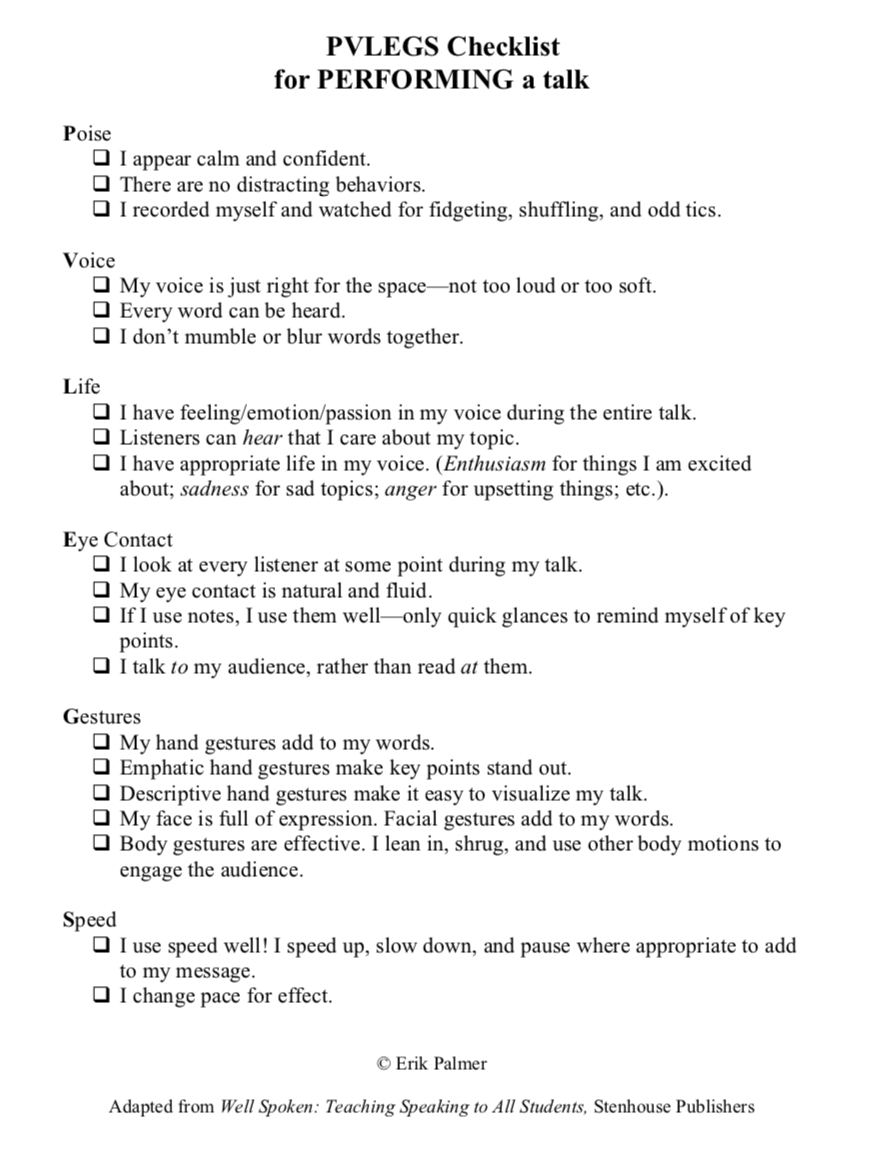
I can help with the first part. Visit www.pvlegs.com. It provides a structure and a common language that has worked very well for students (and adults) for many years. It makes clear that all speaking involves what you do before you speak and what you do as you speak. You can get a sense of the distinction between them by clicking on the checklists at the bottom of this post.

As for the second part, how many of us have given a score for “gestures” without ever teaching mini-lessons on gestures?  Just as we teach pieces of writing (punctuation, commas after an introductory phrase, commas to separate items in a series, commas to join independent clauses), we must teach the pieces of speaking: “On Tuesday, we will discuss and practice emphatic hand gestures; on Wednesday, we will move to descriptive hand gestures; on Thursday, we will work briefly with body gestures; on Friday, we will have a little lesson on facial gestures and expression so that next week when you give your speeches, I can score you on gestures.” Teachers are always talking about teaching reading and writing. Somehow, we never mention teaching speaking.

You already have them speaking. Let’s make those activities more meaningful. Adopt a simple consistent language. Teach specific lessons to develop each skill. It can be done. Do a web search of PVLEGS and you’ll find many teachers who are improving student speaking (and student lives) by helping kids become well spoken. Visit www.pvlegs.com 

Contact me at https://pvlegs.com/contact/ and I’ll send you a free book.

Posted in Speaking | Leave a comment

Essays Muttered Aloud!

The annual convention of the largest association of English teachers in America. The president of the organization addresses the thousands in attendance. A keynote address? Not exactly. More like reading an essay at the audience. Listen to a piece of the talk here.

She had typed out word for word an essay and read it at us. If you look at the six pieces needed to deliver a good talk, she failed at four of them.

Poise? Yes, no distracting behaviors. Voice? Yes, every word was heard…thanks to the microphone. Life? None. No emotion, no passion. Eye contact? Nope, too busy reading. Gestures? No, just holding the sides of the podium and turning pages. Speed? No variation, no speeding up or slowing down for effect.

She is a good writer—it was a fine essay. She is a good reader—didn’t miss a word. But it was an uninspired, sing-songy sort of reading, wasn’t it? Sadly, it reveals a lot about how English teachers fail to understand communication. They love reading. They love writing. Most seriously shortchange the #1 language art, speaking. Oral communication is the way the vast majority of our communication takes place, yet few educators teach students how to do it well.

Yes, every year there is a speaking assignment of some sort. Usually, the assignment comes with a breakdown of what to include in the talk. Always, the requirements are almost all about how to write the “speech.” When I see scoresheets for these, commonly 80% of the total points come from the writing. It doesn’t matter how well the talk is delivered. If you can mutter it out loud, we’ll call it a speech. It will be acceptable and normal. It will get you at least a B. In fact, it will get you on stage at the national convention. But no one will be impressed.

Remember Amanda Gorman speaking at the inauguration? English teachers went nuts! A poem at the inauguration!! None of the lessons created about that event spent one minute noticing that what made that poem amazing was the way it was spoken. None spent time analyzing the wonderful oral communication skills demonstrated. The delivery was as important as the writing. How do we always miss that? Here is a plan for using her poem as an oral communication lesson.

So here we are at the time of year when students do assignments such as speeches, poetry recitations, book reports, and more. Millions of kids will get up and read papers at the class. Listeners will be unimpressed, maybe bored, and will get nothing from the talks. The problem is compounded when weak speaking skills are showcased via podcast and video. Digital tools make mediocre talks seem dreadful, and you know as well as I do that almost no one makes it to the end of even short online talks. If we taught speaking skills specifically, every child would be better at presentation time and recording time. Let’s raise the bar. Let’s not accept essays read aloud.

Visit pvlegs.com for help.

Read this post: Shortchanging Speaking.

Get the book pictured below for free (contact me at https://pvlegs.com/contact/ ).

Posted in Uncategorized | Leave a comment

100 English Teachers Walk Into a Bar

Originally published in California English         

One hundred English teachers walk into a bar. One by one, the bartender asks them why they became English teachers. The first one says, “I love poetry! I write poetry and I want students to love poetry, too.” The second one says, “When I was in 4th grade, I had a teacher that encouraged me to write. I love writing and I want to encourage others.” The third one says, “Reading opens up a world of ideas and journeys. I love reading. I want to share that passion with others.” The 4th person says, “The classics! Shakespeare! The Scarlet Letter! To Kill a Mockingbird!” From the 5th person to the 100th, the bartender gets very similar answers. Finally, he asks the group, “How come not one of you mentioned speaking? Not one of you said, ‘I love speaking, and I want my students to love speaking.’ Not one of you said, ‘I had a teacher in 9th grade who spoke so well, and I wanted to be like her.’ Not one of you said, ‘I have seen speeches that changed the world. I want my students to have that kind of ability.’ How come no one talked about the language art we use most often?”

Okay, so it’s not a joke. It is also not funny to notice that language arts teachers almost always fail to mention the most important language art, speaking. Adults spend twice as much communication time speaking as reading; four times as much speaking as writing. Given that importance, you might think direct instruction of oral communication skills would get two to four times as much direct instruction time as reading and writing. Yet no one seems to value it as highly as other language arts.

It is not what you know that counts, but rather whether you can communicate what you know, and oral communication is by far the number one way of communicating. That has always been true, but oral communication is actually becoming even more important. Think of all the digital communication tools. Skype, Zoom, video calling and video recording on smart phones, video conferences, webinars, and podcasts put speaking skills on display like never before. Those devices demand effective oral language. We should not ignore technological realities and the ways technology increases the demand to be well spoken.

Teaching Speaking

Here’s what I’ve noticed: for reading instruction, we have lessons on letter sounds, vowel and consonant combinations, decoding words, root words, vocabulary, sentence structure, plot lines, fluency, and so on. There are many programs designed to help struggling readers. We have spent a great deal of time analyzing reading and the skills needed to become successful at it. For writing instruction, we have lessons on capitalization, punctuation, fragments, run-ons, topic sentences, paragraphs. There are books and programs designed to improve student writing, to teach us how to confer about student writing, to teach us how get boys to write more, and so on. There are many classes in teacher preparation programs about how to teach reading and writing; many sessions at conferences on the subjects of reading and writing strategies; many books about how to improve reading and writing instruction. Indeed, language arts teachers say “reading and writing” as if they were one word, readinganwriting. It is astounding to me that the number one language art, speaking, is almost never part of the conversation.

Unfortunately, very little time has been devoted to analyzing speaking and the skills needed to become a successful speaker. Do you own a book that is about how to teach speaking skills? (A reading book that has some oral language activities does not count.) The NCTE catalog includes over 200 books but not one is about teaching oral communication. The NCTE annual conference never has sessions about how to teach speaking. Teachers of English don’t think they need to help students with the number one we use English, orally? Have you had workshops in your district about how to teach speaking? You have had several experts come in to help with readinganwriting, haven’t you? Have you been to conference sessions devoted solely to improving students’ oral communication? Most regional conferences do not even have an oral language strand. The most important language art seems to be horribly shortchanged. Yes, every teacher has in-class student speaking activities, but most teachers do not have lessons that lead students to being successful with those activities. Very few teachers have specific lessons on how to use emphatic hand gestures for emphasis or descriptive hand gestures to enhance understanding, or lessons about adjusting pacing for impact. After a book share, a rubric is handed back and students are scored in eye contact and a few other things, but that is about all there is for speaking “instruction.”

None of this would matter if students spoke well. If we saw great book reports, wonderful poetry recitations, terrific explanations, brilliant discussion comments, and so on, we could say that all students have mastered oral communication and teaching specific skills is not necessary. That isn’t the case, is it? Look at students speaking with new eyes. How many impress you? One or two per class? A teacher at a recent workshop commented that summative presentations in her class are PowerPoint presentations that “are often boring recitations of what they read.” Pretty typical of what we all see, right? If one or two students use commas correctly, you are the one who failed, not them. You obviously didn’t teach needed skills. You will go back and offer another lesson about commas after introductory phrases and commas to separate items in a series, and you’ll give some practice activities. You will reteach commas to join independent clauses and have them do some practicing. Yet if only one or two students do well with the presentation after the biography research, you say, “Oh well, that’s just how kids speak.” Why do we sell them short? Why do we fail to help them?

It is likely that most teachers don’t know how to teach speaking. To begin then, let’s establish a framework for understanding what it takes to be a competent speaker so we can impart the necessary skills to our students.

Build and Perform

There are two distinct parts to all effective oral communication. The first part is building the oral communication.  Building refers to all of the things we have to do before we ever open our mouths. For example, consider the teacher who has her students perform an oral presentation on historical fiction. The students have to include certain content (main character, historical events, rising action, etc.), organize that content, make a visual aid (plot line, map, etc.), and dress in a costume from the historical era. All of these things are done before presentation day and all of these are quite distinct from performance skills. These building elements should always be scored separately from presentation elements, just as punctuation should be scored separately from content in writing.

The second part of oral communication is delivering the message. I prefer calling this “performing” because the word performing has connotations that the word delivering lacks but that more accurately describe the task. No two teachers at your school use the same language to assess speaking. Articulation, intonation, vocal modulation, loudly, slowly, clearly, eye contact, presence, expression, pitch, enthusiasm, gestures, body motion, elocution, charisma, hold head up, and many more such terms are used to confuse students. Interestingly, you don’t go into one class and get scored on “Cases appropriately used,” the next on “Large and small letters,” and the next on “Proper uppercasing.” We agree on the key term, capitalization. To help students succeed at performing a speech, we need to agree on the key terms for speaking, too. Here is what necessary and sufficient to speak well: students need to appear calm and confident; make sure every word is heard clearly; have feeling/emotion/passion; look at audience members; gesture with hands, faces, and body; and speak at an appropriate and varying pace. If students do those things, they will be good speakers. In a shorter form, students need to think about

Poise

Voice

Life

Eye contact

Gestures

Speed.

Simple. Understandable. Teachable. Absolutely guaranteed to improve oral language in your class. Years ago, when I wrote those six traits of speaking on the board for students to see, one student called out, “Pee Vee LEGS!” as she made a mnemonic of the capital letters I had written. I have been surprised at how useful that acronym has been for students (and adults) of all ages. ROY G. BIV is odd, too, but it has been very successful, and almost all of us remember the colors of the rainbow because of that mnemonic device. If you master PVLEGS, you will be a successful speaker, and many, many students have told me that they think of the acronym every time they have to speak. Each part of PVLEGS should be scored individually on the rubric. Some students excel at adding life to the presentation but are a bit wiggly; some are totally poised but never look up from their notes; and so on.

The skills described here apply in all speaking situations, not just on the occasions we think of as “speech-making.” In an interview with a prospective employer, a successful candidate will think beforehand about what she is going to say and will build responses to likely questions. Then, being poised, having an appropriate voice, expressing passion and interest, making eye contact, gesturing, and speaking at an appropriate pace will set her ahead of other job seekers. In a committee, a member who comes prepared and has given forethought to what he is going to present will be more valuable to the group. If he pays attention to the elements of delivering his oral communication, he will be an even more effective member of the group. One on one, small group, large group, informal presentation, formal presentation, in-person talks, talks via digital tools—all require building what you are going to say and then delivering that message with PVLEGS. If we used this common framework and language for teaching and evaluating speaking, our students would be much more likely to meet the speaking standards in their states.

Putting the concepts into play

As I mentioned, every teacher at every grade level in every subject has students speaking in class. Do you ever have students give book reports? After listening to 29 of them, are students inspired and filled with a desire to rush out and get the 29 books presented?  Probably not. If you are going to take class time for oral presentation, take time to teach them the speaking skills to do it well. Then perhaps the presentations will inspire students to read the books presented. Additionally, there is a fairness issue here: Don’t assign an oral presentation unless you are prepared to teach students how to succeed at orally presenting. Grading oral performance without specifically teaching speaking skills is patently unfair.

Let’s work with another typical reading assignment. Listen closely as students do readers’ theater. It is often painful and monotonous, and often kills a good story. When you put a new lens on the task, however, students read much differently. After teaching PVLEGS, ask students to think about reading in a new way. They are not “readers” but rather “speakers.” That causes them to look at the text differently. Consider the following passage:

Life is too crazy. We are always busy. We rush to get up, wolf down breakfast, run to school, race to practice, hustle through homework, do our chores… we are always in a hurry. What if one day we just stopped? I mean stopped. Dead halt. Catch your breath. Relax. Take a break. It will improve your life. 

Sometimes a “reader” will read a passage like this word by word, parsing the text with no regard to phrasing and no sense of reading for meaning or expression.

If you ask them to read like a speaker, a change occurs.  A “speaker” will perform the words in the passage. This leads to an interesting discussion with students as well.  Where does the text call for life? Where should pace be adjusted? What did the author do to suggest these things? It is much easier to grasp the concept of prosody when students think like speakers. Orthographic conventions (e.g., commas, exclamation points, italics) are not reading cues but are prosody cues, and thinking of speaking the text makes those cues more meaningful for many students. “Speak” readers’ theater, don’t “read” readers’ theater.

Let’s go one step further. We require rough drafts for writing assignments, right? If you value speaking as you should, require a rough draft for speaking assignments. A rough draft for readers’ theater? Use digital tools. Every computer can record audio and video; every smart phone can do the same. Google Voice will generate a phone number for free so students with low tech phones can call and leave “rough drafts” for you to listen to and use for real examples to aid in teaching key skills. Several tools and Web sites can be used as well. Vocaroo is a free, easy-to-use site that records student voices (http://www.vocaroo.com). Students can visit the site and will find the “Record” button on the first page that opens. No sign-in or registering is required—just click the button and record. When they are finished, the site enables them to email the recording. Every smartphone has audio and video recording tools and products can be easily sent to you. All of these are ways students can practice and ways students can send you rough drafts before readers’ theater in class. All of these encourage practice and rereading. All of these make it clear to students that we value speaking skills.

One hundred English teachers walk into a bar. All of them notice that the only language art used there is speaking. All of them have an Aha! Moment and realize the importance of speaking in life. They realize that their classrooms are oral language dependent, too. They agree to increase emphasis on oral communication skills. Okay, so it’s still not a joke, but I would smile broadly if it happened. Visit pvlegs.com.

Erik Palmer is an educational consultant from Denver, Colorado.  Prior to becoming a consultant, he had a career in business as a commodity trader and a career in the classroom as a teacher of English and civics. As a consultant, Palmer is a frequent presenter at national, regional, and state conferences. He has given keynotes and led workshops for schools and districts across the US and internationally. Palmer focuses on improving students’ listening and speaking skills, making argument and persuasion teachable. Palmer is the author of Well-Spoken: Teaching Speaking to All Students (Stenhouse Publishers, 2011); Digitally Speaking: How to Improve Student Presentations with Technology; Teaching the Core Skills of Listening & Speaking (ASCD, 2014); Researching in a Digital World (ASCD, 2015); Good Thinking: Teaching Argument, Persuasion, and Reasoning (Stenhouse Publishers, 2016); and Own Any Occasion (ATD Press, 2017). He is a program consultant and author of Houghton Mifflin Harcourt’s into Reading and into Literature language arts programs.

Erik’s educational background includes Oberlin College, University of Denver Law School, and the University of Colorado.

Posted in Speaking | 2 Comments