Speaking NOT “Public Speaking”: Why The Difference Matters

I want all students to become better speakers.

Every time I say that I get a response like “Oh yes, public speaking is so important!”

I really dislike that response. Let me explain.

The words have a terrible connotation. “Public speaking” is one of the most loaded phrases in our language, and lots of baggage comes with those words. We all know that public speaking is feared. The cliché is that people fear public speaking more than death. This is obviously absurd. Given a choice between going to a microphone for five minutes or getting killed, everyone would choose speaking. But the damage has been done:

public speaking = horrible experience

Convincing teachers to spend time teaching speaking is harder when I start in such a deep hole. Teachers want to protect students from painful things.

The words limit our understanding of what speaking is. All speaking is, in a sense, public. Unless you are muttering aloud to yourself at home, your speaking is heard by others and is done in public. Whether in a school, a restaurant, a staff meeting, or a store, if someone can hear you, you are speaking publicly. I don’t expect to get agreement that the common definition of public speaking should change, however. I know that “public speaking” makes people think of some formal speech in front of a large crowd.

But I didn’t say I want all students to become better at public speaking, I said I want them to become better speakers. Public speaking as people think of it is one tiny aspect of speaking. A couple of times in life, we may be called upon to do that kind of talk—wedding toast or eulogy perhaps—but we do so many other kinds of speaking every day. Think of the speaking you do. Some of it is one-to-one, small group, informal, in-person, or via digital tool; some is to family, friends, co-workers, students, or parents. You talk in many situations. I want to prepare students to succeed in all of those.

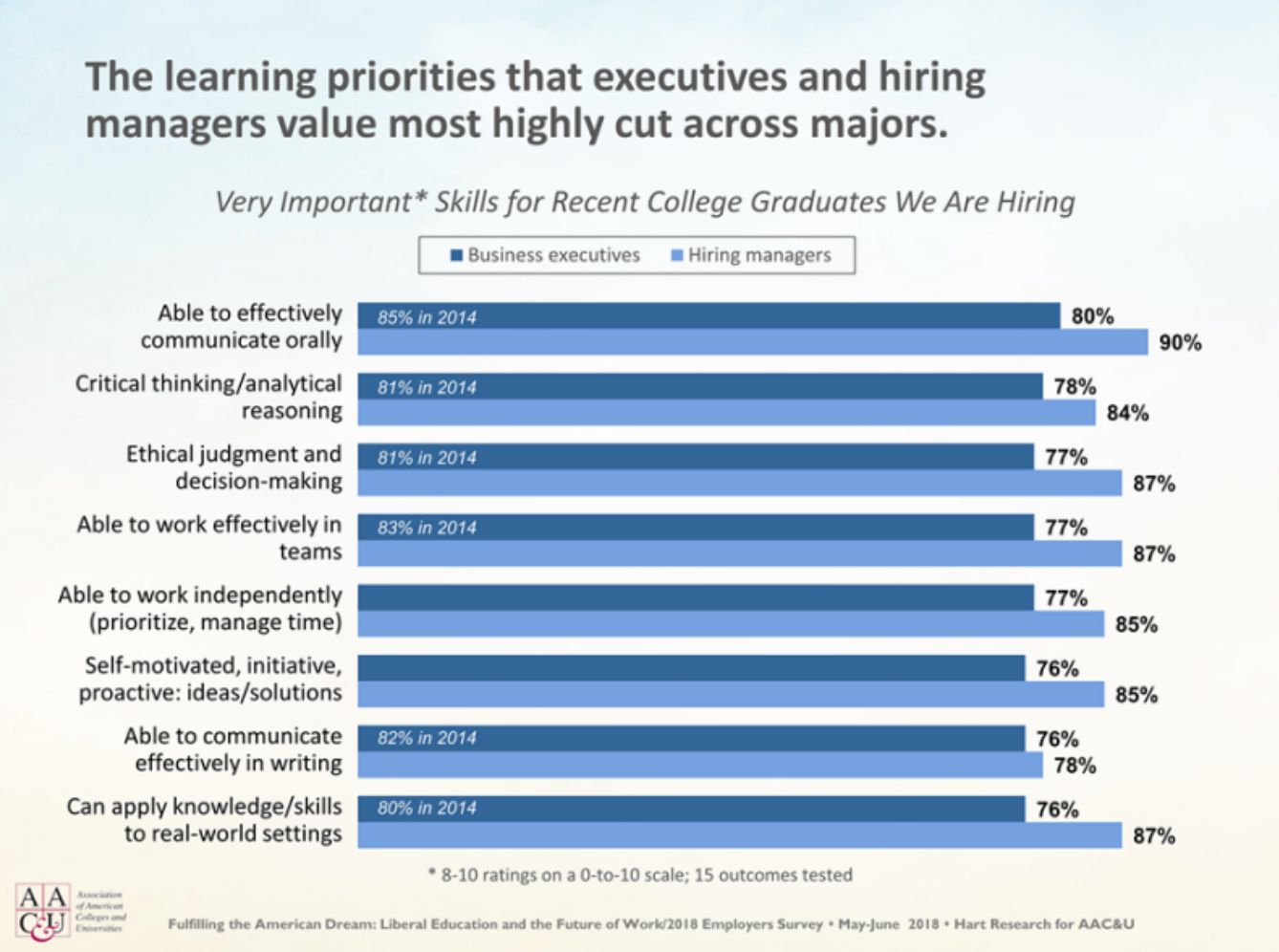
Oral communication is always at the top of the list of skills employers want. The 90% of hiring managers who say that speaking is a very important skill (see chart) aren’t looking for public speakers. They want employees who are generally well spoken. Yes, some jobs involve occasional presentations, but all jobs involve talking. Whether collaborating with co-workers, attending to customers, or fielding client calls, effective speakers are in demand. If we look at oral communication the way the business world does, we realize that speaking is an incredibly important language art for professional success. To conflate “speaking” with “public speaking” causes us to seriously undervalue the need to teach verbal communication skills. It allows us to pretend that speaking will not be important in the lives of most students: few will be public speakers so why teach speaking?

The words make us think about speaking incorrectly. “Speak loudly.” That’s one common response when I ask teachers to tell me specific things that students should do to be good speakers. It is probably poor advice in any situation—you would hate it if a speaker was always loud. In any event, it is a comment that would only apply to public speaking. Remember, I want students to be good speakers across the entire spectrum of oral communication. Speak loudly at a co-worker? Not a good idea. If we think only about public speaking, we will not correctly think about the skills needed for being a well-rounded communicator. In the framework I developed, I replace “speak loudly” with “make every word heard.” That’s it. Good speakers make sure that listeners hear them and that the voice is just right for the space. In a gymnasium, we speak more loudly; on a Zoom call, we adjust the microphone; on a romantic date, we speak softly. In each case, all we want is for every word to be heard. Note that this instruction applies to all types of speaking.

Consider a comment like “Use good grammar.” That doesn’t apply to every situation, either. In the dugout, “That ain’t a strike, ump” works better than “I don’t believe that was a strike, umpire.” Good speakers don’t always use good grammar. They adjust language for the situation and the audience. Adjusting language also applies to all types of speaking. Effective public speakers make every word heard and adjust language for the audience. So do new parents talking to their baby and graphic designers showing their portfolios to prospective employers. Thinking only about public speaking leads us to offer advice that doesn’t apply generally whereas true speaking tips prepare students for all forms of oral communication.

I know I am fighting an uphill battle. I say “speaking” and most people instantly think “public speaking.” But now you know better. Let’s think about speaking broadly, correctly. Let’s give all students an effective voice. Let’s create well-spoken people who are confident and competent verbal communicators in every oral communication situation.

Contact me at https://pvlegs.com/contact/ and I’ll send you a free book.
Posted in Uncategorized | 1 Comment

What’s it gonna be this year?

Inevitably, there is some new initiative, some new program being introduced. If you have taught for a while, you have seen many of these come and go. Maybe last year was the year they introduced the new reading program that replaced the reading program introduced two years ago to replace the reading program introduced the year before. Maybe it will be a new math initiative to replace the “flailing arms” math thing we were all trained in a couple years back. (I forgot the name of it but there were dramatic gestures that all teachers were supposed to use: a certain gesture for addition, a different for division… It died fast and no one uses the gestures now.)

If your career has lasted any length of time you have a list of initiatives that have now gone by the wayside. My list includes Skills for Adolescents, DARE, portfolios, Read On Write On, support groups, equity training, proficiency based report cards, “accordion” paragraphs and “occasion/position statements”, some math program that I can’t remember the name of but I recall as Lucy Liu math though I know that isn’t right, several spelling programs, Harry Wong behavior management methods, some behavior plan that required us to write a name and check marks on the board, C4T (Computers for Teachers), Thinking Maps, and other ideas whose effects were so short that I can’t recall anything about them right now, but I know I have a giant stack of binders somewhere.

Perhaps salespeople selling educational products are extremely talented. Perhaps administrators are exceedingly gullible. In any event, it seems that a requirement of becoming an administrator is the inability to look back and see the pile of failed initiatives. Administrators bemoan the lack of buy-in from teachers when new ideas are presented, but they fail to take responsibility for creating the conditions that created the cynicism.

What percentage of new year’s resolutions actually last? We have an all-comedy radio station in Denver—non-stop clips from various comedians. I missed the name of the comic, but one talked about digging through his closet looking at all the junk he had discarded in there. One of the items was his Rosetta Stone CD set. I spent a couple of minutes researching “what percentage complete Rosetta Stone” but couldn’t find the answer right away so I quit looking. I bet it is a very small number. I’ll wager that a lot of people have the idea of learning a new language but don’t follow through.

Then I started thinking about my health club. Every year in the Before Times, it got crowded during January and part of February, but it got back to normal after that. Seems many people had the idea that “this will be the year they start exercising” but almost none of them follow through. Look at Peloton stock. We were all going to buy bikes and ride them forever!

Screen Shot 2022-09-06 at 4.50.35 PM

I saw a New York Times article that said that 90% of people who lose weight gain it all back. Seems like most folks have the intention to change shapes but don’t follow through. Then I thought about an adult education class offered at the “free university” in my town that told writers how to self-publish a book. The instructor said almost none of the people attending will actually do it. They all have the idea that there is book inside of them and this will be the year that they write it, but almost none of them will actually follow through. Similarly, no administrator follows through with new initiatives. All teachers know this.

I guess my message to admin is settle down. Don’t get so blinded by the incredible possibilities that you forget who you are dealing with here: humans who are very slow to change. When you finally lose that twenty pounds you have promised yourself you would lose and when you get back to the gym to get in shape and when you finish that Rosetta Stone Spanish CD, then start talking to the staff about following through on the last six great initiatives you introduced.

We have to change our thinking about how we decide what to try, and we have to change our thinking about how we present and implement ideas. We can’t continue to waste money on the fad of the moment. We have to look at bigger pictures: What will students need for life?  How do you change teacher behaviors?  What makes an idea last?

We all know the definition of insanity: doing the same thing over and over while somehow expecting different results. We fail to stop the insanity of the “initiative of the year.”

This is free for the asking. No, it’s not a new initiative, it’s just a way to give students voice.

digitally-speaking-rgb-copy

www.erikpalmer.net

Posted in Uncategorized | Leave a comment

Don’t Follow Your Dreams

Dreams have a mystique in America. Teachers tell students to follow their dreams. Friends encourage each other: Go for it! Never quit! You can be anything you dream of being!!! Except…

A dream is a regular idea with a fancy name. That’s all it is. It’s an idea that popped into the head. Understanding that is very important. Why? Have you ever had a bad idea? Ever looked back at something and thought, “Whoa. I shouldn’t have done that. That was a bad idea.” Be realistic: Lots of people have bad ideas. And if a dream is an idea with a fancy name, lots of people have bad dreams, so to speak. Lots of students do, too. How do we deal with “stupid” dreams?

It becomes important because we treat “dreams” so differently than “ideas.” Let me give you an example. I was playing golf at a municipal golf course. My playing partner was 46 years old and announced that he had just quit his job to focus on golf. There is a Senior Tour for professional golfers, and he figured he could make lots of money there. Except he wasn’t that good. If he had said, “My idea is to try out for the Tour and become rich,” I would have said, “That’s a really bad idea. Every year, many touring pros with years of experience turn 50. These guys regularly shoot in the 60’s which is something you have never done. They have years of experience playing under extreme pressure and you have none. You have no chance at surviving the qualifying process to join the tour. Get your job back now!”

But he said, “My dream is to try out for the Tour” instead. Dream? No one can step on another person’s dream, right? So I said, “Oh. Go for it.” Which is really bad advice. Who knows what realistic opportunities he missed by looking in the wrong direction? Who knows what successes he could have had in the business he left to foolishly chase his dream? How did his unrealistic personal self-assessments cost him years later when his dream turned into a nightmare?

You have seen the “Famous Failures” poster, haven’t you? There are a few versions of it. Michael Jordan didn’t make varsity as a high school sophomore; one person said Walt Disney wasn’t any good; The Beatles were rejected by a recording company; Steve Jobs was fired once… AND THEY DIDN’T LET THOSE THINGS STOP THEM FROM THEIR DREAMS!! Follow your dreams, too!!

Should we point out that of the hundreds of millions of Americans who lived in the 20th century, they picked out six? Should we point out the arrogance of comparing yourself to one of these people? Should we point out that for every wrong statement such as “you will never make it as an author/musician/cartoonist/athlete/whatever” literally millions of similar statements were true? Edgy stuff, right?

Do we have a responsibility as educators to teach realistic expectations? The default is “Hey, go for it! Follow your dreams.” Who would dare to challenge that? But are we sending students down the wrong path and shutting down their possibility of developing their true talents? I know some readers are thinking, “Who are you to make such determinations?!” I also know that every reader can think of students (and adults) who had very bad ideas and you knew they were bad. When should we stop parroting the cliché?

Does age matter? Let little kids believe in Santa but tell older kids the truth? When do we share important realistic information? Do the math. There is one president, and he (or one day, she) holds office for four years. It is not the case that anyone can be president. Only one of 333,000,000 can. Do the math. There are five big name pop stars/movie actors/filmmakers/Internet company developers/baseball players/etc. The planet has 7 billion people. Do we have a responsibility to share this? Should we ever say, “You draw well and it will be a great hobby for you, but what else should you be doing?”

The odds are overwhelming that leading students to realistic expectations will be better advice than “Go for it!” Do you want to play the odds? Do you want to educate about reality or encourage fantasizing about what will never be? I struggle with that. I fear I do a disservice by blindly saying, “Follow your dreams.” I wish the kids just said, “My idea is to…”

Posted in Uncategorized | Leave a comment

Ready for the Real World

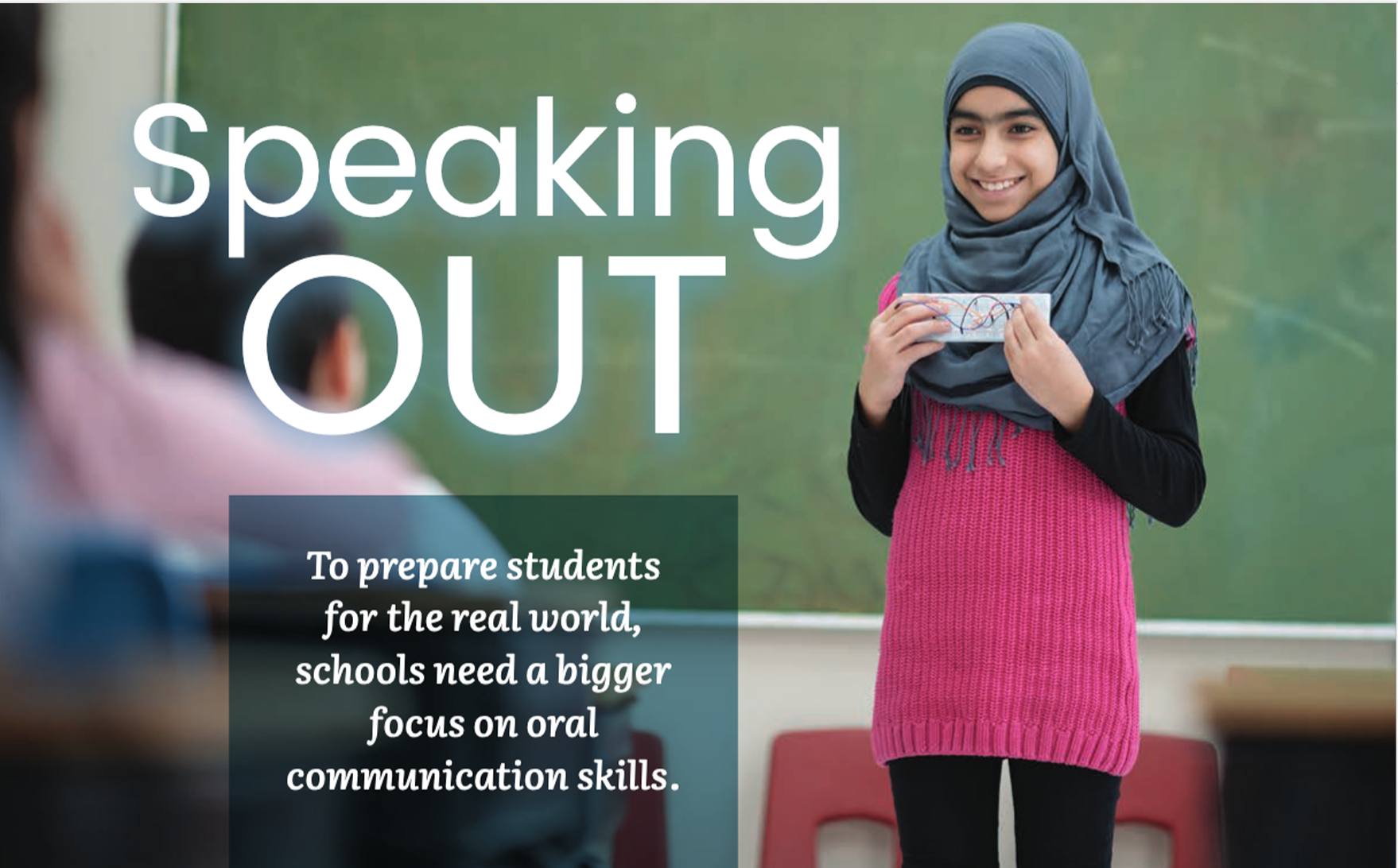
Read “Speaking Out” from Educational Leadership May 2022 issue

Or click here.

Posted in Uncategorized | Leave a comment

Redefining Reading

[This was originally published at the HMH Shaped Blog. I am reposting it in response to the NCTE’s recent position statement which includes these lines:

My wife recently rediscovered her grandmother’s copy of The Scarlet Letter. The edition was published by Houghton Mifflin in 1892. My first thought was, “We’re rich!” It turns out that an 1892 edition is not worth a lot, however. First editions of the book have some value, but first editions are from 1850. This led to my second thought: “This book was written a long time ago!” And that led to these questions:

  • Why is this book still a part of the curriculum in many high schools? Has nothing been written in the last 169 years that has as much or more value than this book?
  • Are we doing unto others what has been done unto us and missing a bigger picture?
  • Is there anything about today’s world that demands teaching something other than what has always been taught?
  • Should the definition of well-educated evolve? It used to be that being well-educated meant being familiar with The Scarlet Letter and other texts in the traditional literary canon. Should there be a new definition now?
  • Has the virtual learning forced upon us by the pandemic increased the urgency to rethink how we teach reading?

Talking like this can cause some upset. I once posted a blog on a site for an educational organization and asked, “Should we think about dropping The Scarlet Letter and updating our instruction?” Let’s just say it didn’t take me long to find out how snarky some people can be. One person said she was going to cancel her membership to the organization. The organization wasn’t responsible for the post, but she was appalled that they allowed it to be posted even though I only asked if we should consider making a change. Don’t touch the literary canon! Yes, some are challenging the white-male aspect of the canon, but we aren’t challenging the book-centric nature of the canon, leaving us stuck with an antiquated idea of what reading is and how it should be taught.

We Must Redefine Reading Instruction

Overwhelmingly, we teach ink-on-paper reading. We obsess over how to get students to read more books. We want them to read poetry. Those are noble goals but are not sufficient to prepare students for the reading they do today. Less than 20% of teens have reported reading books, magazines, or newspapers daily in recent years. Does that mean they aren’t reading? Nope—they are reading online. According to one study, the average 12th grader spends about six hours a day using digital media, with about two hours devoted to each of these: texting, surfing the Internet, and using social media. Those numbers were from the before times. With access to print now diminished by COVID, reading on devices is the norm. Who is teaching students how to read online?

“We aren’t challenging the book-centric nature of the canon, leaving us stuck with an antiquated idea of what reading is.”

Reading teachers usually teach novel structure, haiku structure, textbook structure, short story structure, and strategies for reading ink-on-paper. Now we must teach lessons to prepare students for digital reading. Example lessons for the 21st century should include:

Digital Reading Versus Online Reading

Reading on an eReader (NOOK, Kindle) is text-bound. There is research about diminished comprehension on tablets compared with books, but that discussion is for another day. Online reading is NOT text-bound. Embedded ads cause distraction and hyperlinks can destroy attention and veer us far off track. Warn students about these perils and give them metacognitive awareness of the hazards.

The Cursory Reading Trap

Online reading tends to be cursory. We skim. We read short snippets. We think 140 characters is a full message. Our attention spans shrink and tl:dr is the default. (We don’t even take the time to write out “too long: didn’t read.”) Talk to students about the danger of diminished understanding that comes from superficial reading and help them recognize and resist rushed reading.

How to Do Online Research

There are several parts to this.

  • Even though most students do all research on technological devices, many students still do not know what the Internet is. It itself is not a source of information: it is a web of computers linked together. What is found on that web is information on somebody else’s computer. Are they reliable? See this blog post I wrote for Shaped.
  • Many students don’t know what Wikipedia is even though they use it all the time. It is crowd-sourced information that is editable by anyone. There are advantages to that (many potential experts contributing instead of a couple of authors, for example), but there are disadvantages (pages get prank-edited). Show the History and Edit tabs to students and stress the need to check for the “bibliography” of the Wikipedia page: links to other sources at the bottom. No links? Trouble.
  • Past searches determine future results. Searching “Are vaccines harmful?” starts a user profile. Algorithms think, “Ah, this person dislikes vaccines so I will send anti-vax information.” Encourage students to go beyond the first three results and seek out multiple viewpoints.

How to Ferret Out Fakes

We know that fake news exists. We know that social media spread falsehoods. Teach strategies to help students avoid being duped. You can start by following the advice in these blog posts:

How to “Read” Sound and Image

Words are often accompanied by pictures and music. Those impact how we interpret the words. Teach students how to be critical analysts of sound and image rather than passive receivers. You can start with this blog post.

The bottom line is that reading now is radically different than reading was a short time ago. We have to recognize and react to the change. Ditch The Scarlet Letter. We have way more important things to do.

Posted in Uncategorized | 1 Comment

Talk First. Write Later.

“F9. Action”

That was Mason’s response to the prompt “What’s your favorite movie? Why is it your favorite?” It was part of a Getting to Know You assignment at the start of the 6th grade year. I had to look up F9. Turns out it is the abbreviation for “Fast & Furious 9,” the ninth movie of the Fast & Furious saga. This brought up three questions:

There have been nine Fast & Furious movies?

Should a 6th grader be watching Fast & Furious movies?

How can I get Mason to write more?

I’ll just talk about the last question here. Every teacher has reluctant writers. In Mason’s case, he was two or three grade levels below his peers in writing. He knew he was not good at writing. Years of extra support and encouragement haven’t changed his opinion of writing or markedly improved his writing ability. I think I know why.

In school, we tend to focus on deficits. If a child is behind others, we try to address the deficit. Difficulty reading? We’ll give you more reading to try to bring you up to speed. Difficulty with math? We’ll give you more math. In my school, we took students out of electives to give them extra classes in their problem areas. Mason couldn’t take Media Production because he needed the remedial writing class. (Yes, we changed the name of the class and didn’t use the word “remedial.”) To Mason, this was double punishment: unable to take a fun class and forced to do more of what he hated.

But here’s the thing about Mason: he was an amazing storyteller. Ask him about F9 and he would light up. Describing the cars, the chases, the actors in an engaging, animated way? Absolutely. Wonderful gestures, facial expressions, and speed variations as he spoke? Definitely. Mason was one of the best student speakers I have ever heard. Unfortunately, in seven years of schooling, no one noticed. Everyone focused on what was wrong with Mason. Everyone focused on his reading and writing.

Teachers seriously shortchange oral communication. English and language arts teachers talk about “reading and writing” almost exclusively and rarely mention speaking. Why? In part because speaking is not on the Big State Test. Mostly, though, we have misconceptions about speaking. Many teachers think speaking is scary so we shouldn’t make students do it. Many teachers think speaking skills can’t be taught and students are born with speaking ability or not. Many teachers don’t see how speaking is the key to reading and writing. From Mason’s point of view, though, writing is scary. He noticed that some kids were good at writing from the start and seemed to be born with more ability. And Mason couldn’t write until he was allowed to speak first.

Here’s what that means. Before making students like Mason write, let them talk. Record audio or video of them as they respond to a prompt. Consider letting them turn in the recordings instead of making them write. Because that can’t be allowed all the time, use the recordings to guide the writing.

         Teacher: Mason, you have done a great job describing F9. I can really see why you love that movie. Let’s listen to your storytelling and use what you said as a guide for your writing. I’ll play the first minute of your talk and pause the recording so you can write down some of what you said.

The result? Mason’s writing: F9 is for fast & furius 9. Its the nine fast & furius movie. I saw all movies but F9 has the best cars. Theres a Dodge Charger that cost a million dollars to make and this Ford Mustang chase by hellicopters. Jhon cena is driving that one Hes really cool. [sic]

A bit better than “F9. Action” isn’t it? Now we have something to work with.

How can you fit this in?

  • If you have Google Docs open on a Chrome browser, let a student use Voice Typing, one of the Tools available. As students are writing in class, allow Mason to go out into the hall and speak his rough draft into the computer. Windows OS has speech recognition, also.
  • Look for Dictate on Microsoft Word.
  • Do you use peer editing? Some students will be looking at each other’s writing. Mason and his partner could be listening to recordings and helping each other transcribe.
  • If Mason has access to a phone, have him call your Google Voice number and leave his rough draft. Google Voice will transcribe it. You can show the text to Mason so he can use it to write his final draft. Older students will easily find apps that transcribe.
  • Consider letting a spoken assignment replace one of your writing assignments. Listen to the response to your prompt, instead of reading the response.

For an example of a writing assignment where a student spoke instead of wrote, I’ll share Ryan’s video. My civics students were asked to write about what democracy means to them, but Ryan hated writing. He asked if he could submit a video. See the result here: https://youtu.be/0_TJBfL5gzs. If I had forced him to write, I might have gotten two boring paragraphs.

All of us spoke before we read or wrote. For many students, speaking first is still the best idea. Don’t just focus on reading and writing. Look at speaking with new eyes and let the many students whose strength is speaking use their talents as a bridge to reading and writing.  

Contact me at https://pvlegs.com/contact/ and I’ll send you a free book.

Posted in Uncategorized | Leave a comment

Blame the messenger–Why Communication Fails and How to Fix It.

You’ve heard the phrase before. Someone brings you some bad news, and, as you begin to get upset, he says, “Hey, don’t blame the messenger!” In a school I worked at, our team leader said it often. He went to all the meetings and came back with reports of all the new things we had to do: new initiatives we had to implement, new tech tools the school purchased that we were supposed to put into play, new [math/science/bullyproofing/grammar/insert your own idea] program we had to use. As we got agitated and began to complain, he always used the phrase on us. It certainly seemed fair. Why vent at him when it was the new things we hated? Don’t blame the messenger.

Lately, I have come to think differently. There are cases where we should blame the messenger. I have seen many good initiatives dead on arrival because of how poorly they were presented. I have seen well-meaning administrators create ill will because of the way they spoke to the staff. When all of us became online presenters because of the pandemic, it was more apparent than ever that weak speaking is a problem. It dooms instruction. No one, child or adult, wants to listen to hours of mediocre to poor oral communication. Add all the other options available online and we can’t be surprised that students and staff are tuning out. You wouldn’t watch this stuff either.

Let me give an example of how poor oral communication can ruin good intentions. I attended a talk about making more effective use of technology in instruction. I think the message is an important one. Many teachers were putting their students in the position of being time travelers: the students are in 2024 outside of school, but when they come into the classroom, it looks like 1980. Few teachers have expertise in the effectively using digital tools, and many were hesitant or resistant. We can kid ourselves, but change is difficult, and teachers are generally buried. Planning, grading, parent meetings, school meetings, and shifting requirements are all-consuming. The tech teacher may have the time and interest to explore all the new tools, but the average teacher doesn’t, so someone has to be the messenger to bring the new information to the teachers. And that messenger had better be good. Think of how much better prepared we would be for remote learning now if we had had better presentations about it.

Which brings me back to the talk. What was really needed there was a high-powered communicator with excellent oral communication skills. First, the speaker had to make sure the presentation was well built. To start, it should have been created for the audience: teachers giving up their time and paying for a couple days of sessions who are not really looking for complicated jargon or some glitzy new tool. I was stunned that the presenter seemed to have no idea what the audience was thinking. The speaker should have well designed visual aids that engage the audience, but instead we saw the typical PowerPoint slides with bullet points and a massive list of “apps you must have.” Who wants to see that?  The speaker should have content that is understandable, but instead we were buried with a quick explanation of the 25 tools we should be using. Way too much, way too fast, way inappropriate for those who aren’t tech savvy. Before the speaker ever opened his mouth, the presentation was doomed. It was poorly constructed. (Check out a collection of bad slides to use as examples of what NOT to do.) How well built is the online instruction that you  are seeing out there today?

Of course, after a presentation is created, it has to be delivered. Speakers presenting new ideas need to be really good. Selling change requires exceptional skills. A speaker has to be lively, engaging, animated, powerful, and maybe humorous. These are necessary to sell any new idea. Unfortunately, the speaker was none of those. Most attendees left the session before it was over. Blame the messenger. He ruined the presentation and poisoned the idea of using valuable tech tools. Too bad. We could have used an inspirational message to get us psyched to use the tools we now need to use for remote learning. And when we move from live to online, speakers have to be much much more lively to be engaging. Online speaking is a performance art. Talking at kids doesn’t work. How impressive is the speaking on the videos and screencasts you’ve seen created?

Everyone can benefit by improving their speaking skills. We are the messengers. How many great ideas in your school died because they were presented poorly?  How many teachers got upset because an administrator communicated poorly?  How many times have you looked around at a staff meeting and seen glazed eyes and clear disinterest? How many good lessons have been ignored because no one wanted to continue to listen? If these have happened, blame the messenger. Or better yet, get help. Check out Own Any Occasion. (Find it here)

See also Don’t Hit Record Yet.

Posted in Remote Learning, Speaking | Leave a comment

Give Students a Digital Voice First

You want students to speak to the class. Maybe they are sharing What I Did This Summer or About Me presentations to start the new year. Later, students will be reciting poetry or participating in a mock trial or presenting their research reports or giving a book talk or making a podcast. Every teacher has speaking activities. I’ve written elsewhere that all students tend to dislike these presentations in large part because we have never given them specific, direct instruction about speaking skills. (See https://pvlegs.blog/2019/11/16/100-english-teachers-walk-into-a-bar/.) I want to talk here about the few students who have another problem with public speaking.

Introverted. Shy. Lacking self-confidence. You know these kids and you have several of them in your class. Even if you gave specific lessons about how to speak well, they would still be reluctant to get up in front of the class. We can’t give in to that fear, though, because oral communication is the number one way adults communicate, and we don’t want to rob any child of her or his chance of success. Some kids hate math, some hate writing, I hated art (It was supposed to be a cat!), but we want to help all students become complete and competent in all areas. Including speaking.

A solution? Give kids a digital voice first. Don’t have the students get up in front the entire class live. They aren’t ready. Use one of the many digital tools available. Students can record, delete, rerecord, delete, rerecord until they have something they are proud to share. Move from a high-stakes, live show to a low-stakes but-still-developing-speaking-skills show.

Many recording tools are available. Every smartphone has audio and video recording capability. Flipgrid (https://info.flipgrid.com/), VoiceThread (https://voicethread.com/), and Voki (https://www.voki.com/) are examples of sites where students can record presentations, discussion comments, and more. (Send me your favorites—I’d love to add to the list.)

Here’s a look at Voki. I use it to work on one of the skills of effective speaking, adding life to the voice. Students choose an avatar and add a fun voice: https://tinyurl.com/y9fns652

Voki can also be used for presentations (click on the avatar next to the book to start the presentation):

See https://pvlegs.com/ for more ideas.

The bottom line: Speaking skills are important. ALL students need help, and some need a way to dip a toe in the water before they dive in. Don’t shortchange the #1 language art, and don’t shortchange any student. Use digital tools to develop student voice.

Posted in Uncategorized | Leave a comment

Listen to the Rough Draft of the Talk. Yes, LISTEN…

Do you ever ask to hear the rough draft?

Yes, you read that correctly. I want to hear my students’ rough drafts. Every day, students are speaking in class. Often, teachers assign some talks with higher stakes than the daily discussions, answers of questions, and the like. We assign the quarterly book report in front of the entire class, the biography project final where students dress up as some historical figure, the report on smoking’s effects in health class, the presentation of the science project, the participation in a mock Congressional hearing, the talk at the DECA competition, and many more. At all grade levels in all subjects, at some point students will be giving a talk to a group. Before we expose the audience of students and/or parents and/or judges to these talks, we need to make sure that the talk is ready for prime time. I tell students to practice several times before presentation day, but, not surprisingly, some students do not practice. I am sure this is just an issue I face, and you never have this problem. To avoid that problem, though, I ask to hear the rough draft before my students give the final talk. I ask students to send me the rough draft recording of their talk so I can listen to it and offer advice. I don’t want to read the words they wrote, I want to hear them speaking. Do you ever do that?

Checking the rough draft is common for many writing assignments. The cynical among us may suggest checking the rough draft as a way to make sure students are doing the work they are supposed to be doing. The fear that the paper may not be started until the evening before the six-week assignment is due is real. Less cynical teachers may look at the rough draft as a formative assessment. Discovering mistakes and giving feedback before the final paper is due is more valuable than writing comments on the finished paper. For both reasons, I always asked students to do a rough draft before they handed in a major writing assignment. I collected and commented on the drafts and warned students that I would get quite miffed if those comments were ignored. I want the same thinking to apply to oral assignments—but with a twist. Don’t have students hand in a paper with the words they are planning on saying; require a recording of the talk instead.

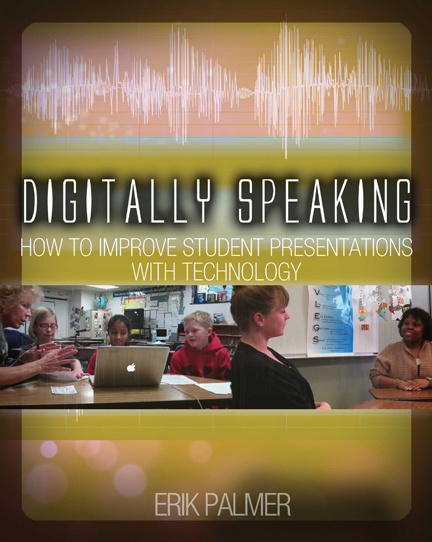
There are many ways to record the rough draft. All of them contribute to preparation for your state’s speaking standards, by the way. While the Common Core Standards have fallen upon hard times, they left a mark. Speaking standards in most states have modeled ideas from the CCSS. For example, standards usually require students to use multimedia in presentations. In my state, beginning in second grade, students are expected to make audio recordings of talks; by fifth grade, students should be including multimedia components in presentations. This requirement is probably more daunting to teachers than to students. More of our students than you realize are already quite adept at various ways of recording and posting audio and video. Today, I want to share some of the simpler ways we can record, and show you how to use digital tools to practice talks. Digitally Speaking: How to Improve Student Presentations with Technology is a source for those wanting more ideas and it is free for all teachers. Just contact me through pvlegs.com to get a copy.

Every computer/netbook/tablet has built-in audio and video recording. Every device has recording capability and your students will have no trouble finding it. In the distance learning world we all entered last year, students are becoming masters at using these tools. Have students record themselves and attach the recording to an e-mail to send to you. Use Google Voice and have students call your number and leave a message: a couple minutes of their speech. Tell students to visit www.vocaroo.com. There’s no sign-up, no password, no cost—the home page has a big red button that starts the audio recording. When students finish, they can “Listen” to the recording. If the recording is not good enough, they can hit “Retry”; if they like it, they can copy the URL address to send to other listeners or hit a button that lets them e-mail the recording to someone . . . a teacher, for instance.

Try voki.com. Students can create presentations using an avatar and share it with you. See an example here.

Think of the possibilities. Students can watch/listen to the recordings, critique themselves using a PVLEGS rubric, make adjustments, and improve. Audio and video can be shared in a group: each group member shows his or her rough draft and gets feedback from other group members. Recordings can be viewed by a teacher who can give important tips to improve a presentation before the due date. A Reader’s Theater team could record parts and send them to teammates as a way to improve before performing the book selection in class. The Poetry Café presenters can listen to themselves before getting up in front of classmates and parents. The recordings of a “This I Believe” speech could be useful formative assessments on the way to the final talk. And, of course, you have your own great ideas.

Why wouldn’t you want to do this? Improving speaking skills, avoiding dull presentations, updating instruction, and meeting state standards can all be accomplished by asking to hear the rough drafts.

Erik is the author of Digitally Speaking: How to Improve Student Presentations with Technology and Well Spoken: Teaching Speaking to All Students.

Posted in Media Literacy, Speaking | 1 Comment

What the Oscars can tell us about speaking

Are you going to watch the Oscars this year?

In the Before Times,  I attended an Oscar party. As the guests came into the party, we were given an Oscar “ballot.”  Each of us marked off our predicted winner for each of the many awards to be given. While this could be used as a wagering tool, we simply used it to help sustain interest during the long show. “Yes!  Best black-and-white short documentary in a foreign language! I have five points now!” As I marked my ballot, I noticed that there are many awards for acting and many for writing. This is not a particularly astute observation. I am sure you noticed this as well. What may have escaped your notice is how profoundly this distinction should impact the way we understand and teach speaking.

Someone creates the words. Someone delivers the words. These are two distinct talents.  The writer is probably not a great performer. The performer is not likely to be a great writer.  But all speaking involves these two very different parts. Whether we are speaking one-on-one, in a small group, or to a large audience, and whether we are speaking in-person or via digital tool, both parts are involved. And for all us regular folks, we have to master both parts by ourselves.

Understanding the distinction between creating and delivering is the first step in becoming effective teachers of oral communication. I refer to these two parts as building a speech and performing a speech.  “Building” refers to everything we do before we open our mouths. “Performing” refers to everything we do as we are speaking. 

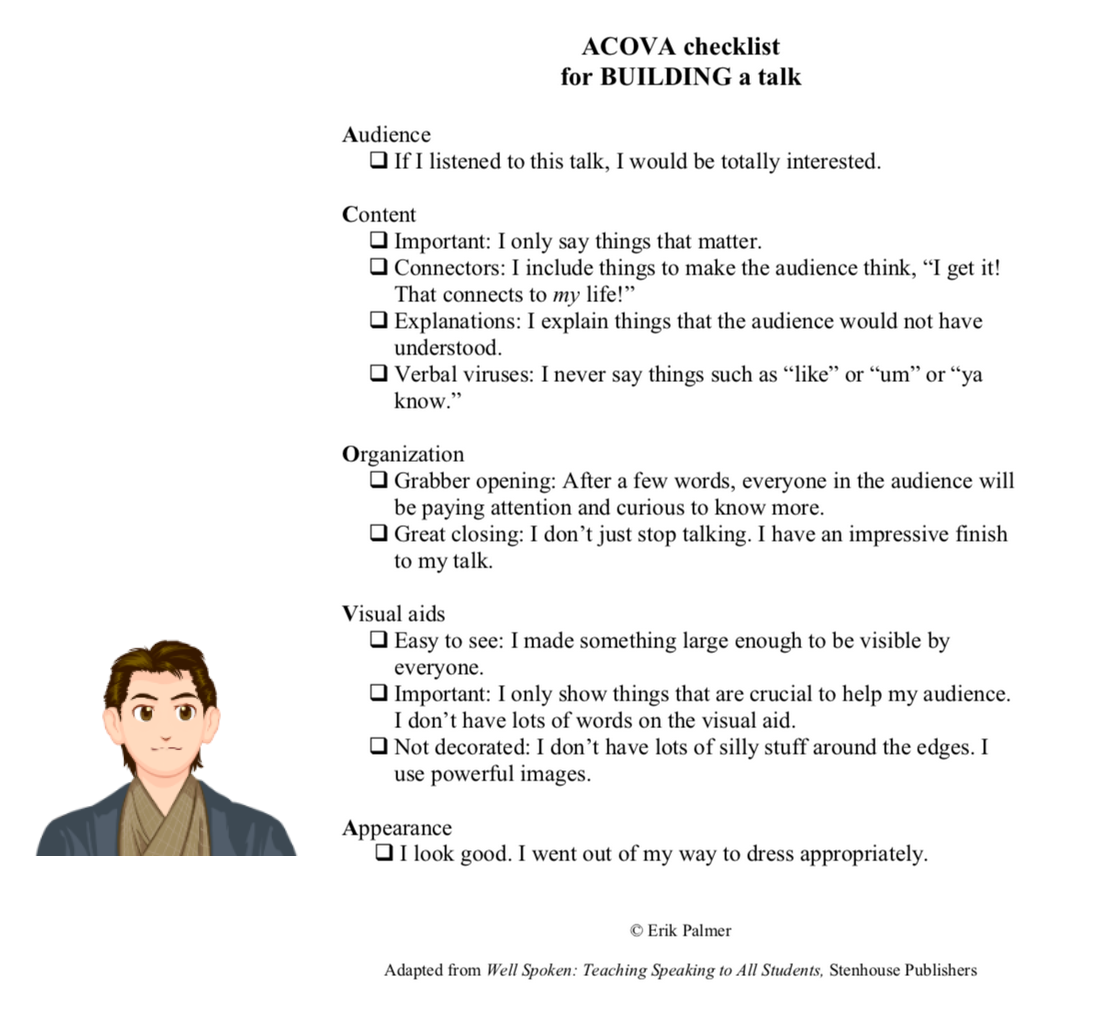
Let’s think about building a speech first. Sometimes the process is instantaneous—coming up with what to yell at the umpire after a bad call. Sometimes we work hard to construct our comments—deciding what to say at the eulogy. But before we speak, we do certain things.  If we are to be effective, we think about the audience and design our talk specifically for them; we come up with content; we organize our words; we may design some aids for the talk; and we adjust our appearance to fit the situation. Again, we do this for all verbal communication, whether our audience is one person (e.g., interview), a few people (e.g., staff meeting or discussion), or many people (e.g., in-person presentation or Zoom conference). We often do these things without giving them all as much thought as we should.  Some people are very good at building speeches (professional speechwriters exist, right?) and some students will excel at this part of oral communication. All students, though, and indeed, all speakers, need to understand what is required before we ever utter a word.

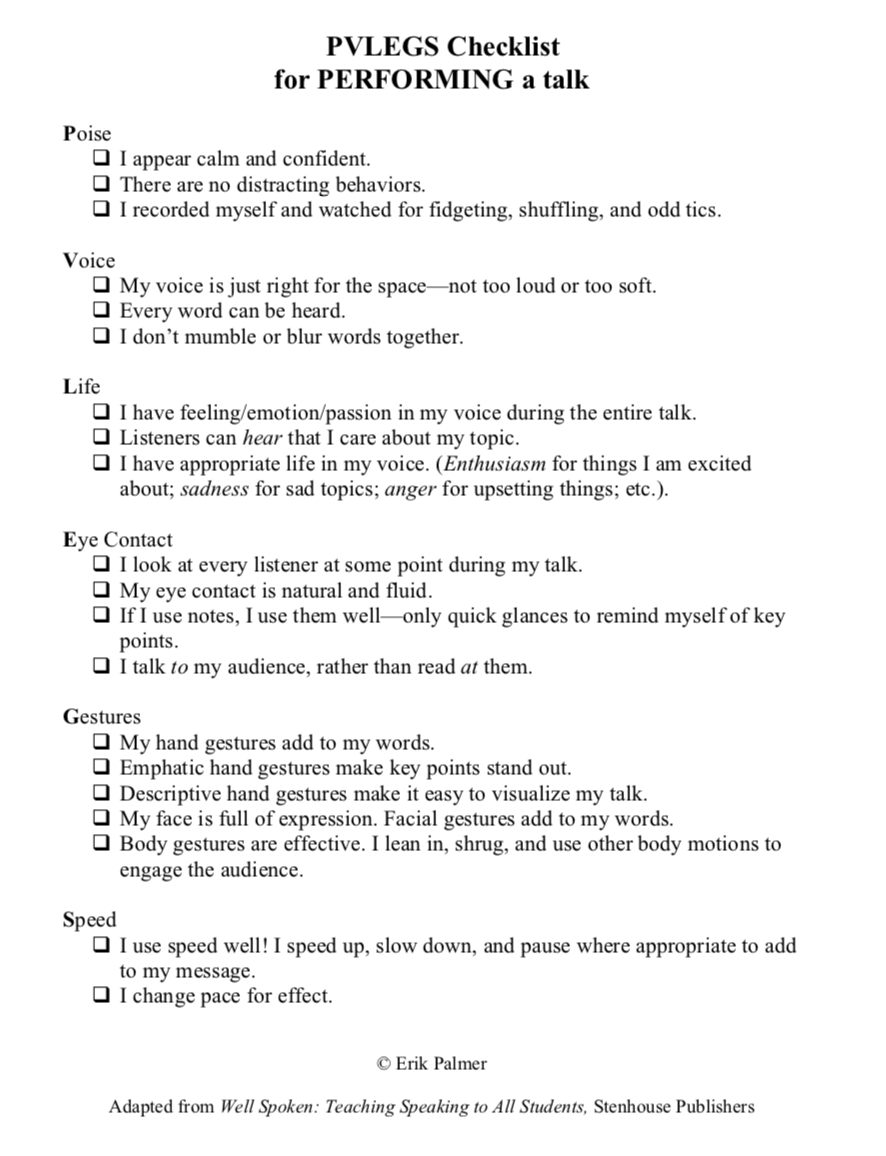
Of course it makes no difference how well remarks are constructed if they are never spoken. I prefer to use the word performance rather than the word delivery because I think the former does a better job of conveying what is really involved. In any event, as we speak, we need to do certain things. We need to be poised; we need voices that make it possible for every word to be heard; we need some life in our voices to avoid being dull and boring; we need to make eye contact with audience members; we need to gesture; and we need to pay attention to speed and pacing.  If we do those things, we will be effective conveying the message no matter what the situation is—interview, discussion, or presentation. Some people are very good at performing (professional speakers exist, right?) and some students excel at this part of oral communication. But, again, all students need to understand what is required as they speak.

I realize that there are many ways to describe the skills I refer to here. We have buried our students with an impressive number of descriptors: content, subject knowledge, information, appropriate facts, the 5 Ws, clear message, articulation, enunciation, elocution, speak clearly, intonation, expression, inflection, enthusiasm, and so on. I will make an argument for consistency and simplicity another day. Whatever language you use, clearly separate the words that describe what we do before we speak from the words that describe what we do as we speak.

I sometimes get a “Well, duh” reaction when I explain this, as if everyone already knows this. At some intuitive level, I think we all do know this but look around your building. How many teachers specifically talk to students about this crucial distinction? How many score sheets and rubrics are being used in your building that don’t keep these separate (e.g., “Content, vocabulary, and delivery are appropriate”)? How many students can articulate, “Well, I’m pretty good at constructing a talk but not so good at giving it” or vice versa? If we all know this, why do I see so little evidence of it?

The distinction between building a speech and performing a speech is profound, and understanding that distinction will make a profound difference in the way students and teachers approach all oral communication. It is the starting place for mastering speaking. Visit pvlegs.com for more ideas. Use these checklists to help all students become well spoken: Building a Talk and Performing a Talk

PVLEGS pic

Posted in Speaking | Leave a comment