“Fake News” is frightening…but not the way you think it is

Millions of Americans do not believe Joe Biden was elected president. Every election until now reported results and every citizen accepted that those results were accurate. How did we get to a point where millions of us do not believe what has been proven over and over?

Because while you were teaching students to not believe fake stories, Donald Trump was teaching Americans to not believe true stories.

Beginning five years ago, Donald Trump criticized the media, targeting specific people, networks, and papers. Initially, he picked on the New York Times and CNN. Now, even Fox News is on his hit list (see an article here). Originally, almost all news sources were called “fake news” by the former President. Then they became enemies of the American people. Attacking the press was a key part of his presidency from the early days.
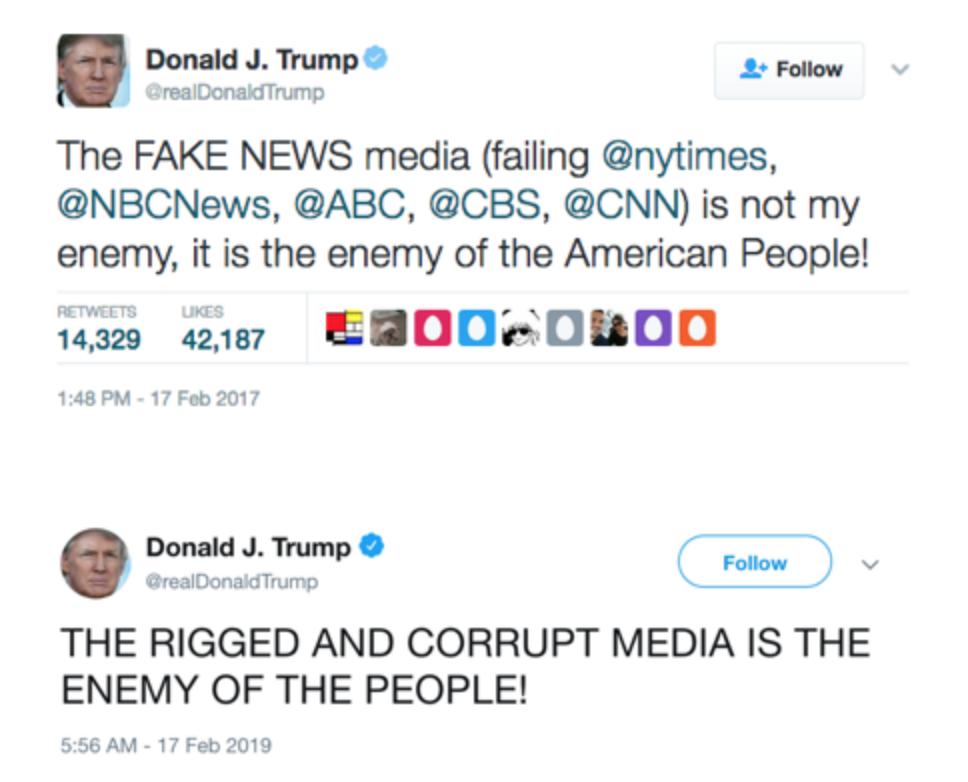
Screen Shot 2020-01-24 at 8.28.57 AM

All reporting is wrong. Don’t believe anything. Those were the messages received non-stop.

But is it dangerous to destroy belief in the media?

MISUSING THE WORD “FAKE”

Fake means false. Didn’t happen. Reporting that a poll that says 32% of the people trust the media is not fake if in fact such a poll existed. That some other poll might have different percentages does not mean that the first story was fake. CNN, ABC, NBC accurately reported the polls in the election. That the election turned out differently does not mean the stories were made up.

Not covering a story or only covering part of a story does not equal fake news. If there were big crowds on one side of the street supporting Black Lives Matter and counter protestors on the other side of the street, showing only one side of the street is misleading. Ignoring the other side of the street may be evidence of bias, but bias does not mean fake. The people shown were actually there. There is a huge difference between choosing one view over another (bias) and reporting something that never happened (fake). Pointing out bias is fair. Denying the truth is sinister.

THE PROBLEM IS NOT WHAT YOU THINK IT IS

Our first response to “fake news” as educators was to teach students how to sniff out fake news. We pointed out that some stories were totally false. Made up. Never happened. No truth. We wanted to give kids tools for figuring out which stories were fabricated. But teaching students how to find lies has turned out to be a much smaller problem than the frightening issue with “fake news”:

I am a little worried that students will believe something that is false.

I am terrified that students will not believe something that is true.

While we emphasized the small amount of stuff that is nonsense, we missed the incredibly serious risk of creating cynics who feel comfortable disregarding truths. One of the most important pieces of civil society was undermined while we were watching. Millions of us do not believe that which is true.

THE IMPORTANCE OF THE PRESS

A little history. Within minutes of creating a new country, our Founding Fathers decided to make ten changes to the Constitution. The very first change they proposed?

Congress shall make no law respecting an establishment of religion, or prohibiting the free exercise thereof; or abridging the freedom of speech, or of the press; or the right of the people peaceably to assemble, and to petition the Government for a redress of grievances.

Amendment 1 protects freedoms of religion, speech, press, assembly, and petition. The Founders were worried that these freedoms, not specifically mentioned in the articles setting up the government, could be attacked. Before anything else, they wanted to guarantee these freedoms.

…the freedom of the press, as one of the great bulwarks of liberty, shall be inviolable. James Madison

Our liberty depends on the freedom of the press, and that cannot be limited without being lost. Thomas Jefferson

The Founding Fathers realized that a free and respected press would help hold government leaders accountable, publicize important issues, and educate citizens so they can make informed decisions. Attacking the press, then, is a very dicey proposition. If the press is demeaned, those three things don’t happen. Who will perform those functions? This is not a liberal or a conservative issue. Both ideologies agree that a free press is critical to a well-functioning democracy.

Yet if our right to a free and independent press is infringed, all other rights fall. Our ability to be informed and the free flow of information, regardless of how damaging it is to elected officials, is one of the most essential safeguards to our liberty. The fight for a free press is one that we absolutely cannot afford to lose. http://www.freedomworks.org/content/flashback-founders-necessity-free-press

The press, which is essential to the preservation of liberty, has also come under attack from the government. One of the principles that ensures a free press is that journalists are not required to reveal their sources. This is one way government whistleblowers can feel free to come forward and reveal information that is of public importance, such as governmental corruption and abuse, without fearing exposure. If journalists were required to reveal their sources, scandals involving government corruption and wrongdoing such as Watergate might never be brought to the attention of the media and, thus, the American people. https://www.rutherford.org/constitutional_corner/amendment_i_freedom_of_religion_speech_press_and_assembly

DESTROYING FAITH IN A CRITICAL INSTITUTION

The non-stop barrage of “fake news” had an effect. Distrust in the media is increasing. From Gallup analyst Art Swift:

Americans’ trust and confidence in the mass media ‘to report the news fully, accurately and fairly’ has dropped to its lowest level in Gallup polling history, with 32 percent saying they have a great deal or fair amount of trust in the media. http://thehill.com/blogs/blog-briefing-room/296003-poll-trust-in-media-at-all-time-low

The numbers are radically different based on party affiliation: 14% of Republicans, 30% of independents, and 51% of Democrats trust the media. According to an Emerson College poll, 91% of Republicans think the news media is untruthful (47% of independents, 31% of Democrats). http://thehill.com/homenews/media/318514-trump-admin-seen-as-more-truthful-than-news-media-poll At the extreme, Trump supporters shouted “luegenpresse” at a rally (see the article here).

In other words, Trump’s strategy worked. That many Americans do not believe that the 2020 election results are real and that COVID is a hoax proves it. It’s all fake news and there are no longer accepted facts.

EDUCATORS MUST RESPOND

It is not enough, then, to teach students how to ferret out falsehoods. It is critical, yes, but more is needed. We must set the context. We must explain the importance of a free press. We must explain the core principles of our Founding Fathers. We must point out how rulers around the world and throughout history have attacked the press in order to subjugate the citizenry. We must make clear that a free press is never the enemy of the people. And yes, we have to risk upsetting some people by making clear that Trump was frighteningly wrong.

 

Posted in Media Literacy | 1 Comment

Speaking Well Does Not Mean Speaking White

I didn’t think I would have to clarify that. But I had an interesting experience over a tweet I wrote.

My tweet:

An irate response to that tweet: “How dare you tell students that you must speak a certain way! Who are you to insist that only white, middle-class speech is appropriate?”

This provides some important lessons for all of us. First lesson, read before you react. Don’t fly off the handle and make ridiculous (stupid?) assumptions. Had the person read the article or anything else I have ever written, she would have known that I never come close to suggesting that there is only one approved way of speaking. I have made that clear many times in my work, including here. https://www.td.org/insights/code-switching-its-not-always-proper-to-speak-properly A small exploration of what I have written would reveal that the skills I suggest teaching apply to all styles. The comment is as absurd as protesting teaching comma usage. “How dare you tell students that commas are used to separate items in a series! That’s racist.”

Second lesson, we have no idea what it means to teach good speaking. What good speakers do can be done in any language, dialect, or social group. In other words, the skills of effective speaking are neutral: gender neutral, ethnically neutral, politically neutral, religiously neutral, and whatever other kind of bias you are worried about. I’ll give you a couple of examples. All speaking involves what you do before you speak and what you do as you speak. I refer to these as building a talk and performing a talk.

One thing to address before you open your mouth is to analyze the audience. You should plan a different talk about magnetism for third graders than you do for twelfth graders. You should plan a different talk about math manipulatives for teachers at the math department meeting than for parents at Back to School night. You should use a different style for the interview committee at IBM than for the teammates in the dugout. I use a different style for my stand-up routine at the comedy club than for my keynotes at district PD days. Analyzing the audience is a tip for all speakers who want to be successful. It is not class or race specific.

One skill to think about as you are speaking is speed. Great speakers know how to use speed well. They can speed up to create excitement. They can slow down for emphasis. They can stop for dramatic effect. Watch any truly impressive speaker anywhere on the planet. Watch speakers speaking a language you do not understand. That way the message won’t distract you, and you can pay attention to the delivery. You’ll discover that great speakers adjust their pace. Yes, the pace can and should be influenced by the audience analysis. Slam poets tend to speak more quickly than TED talkers. But all effective speakers know how to adjust speed for impact. Learning how to play with pace is tip for all speakers. It is not gender or ethnic specific.

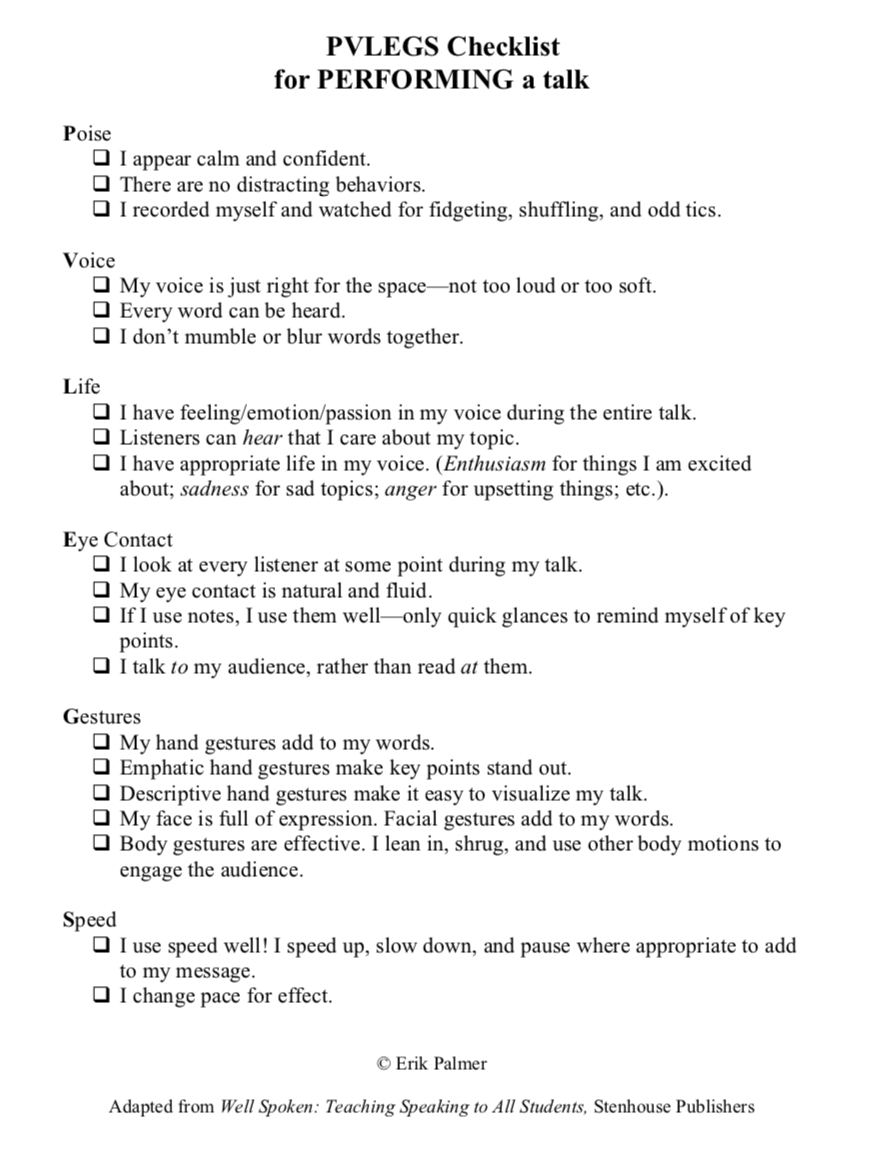
If you are curious about the five skills needed to create powerful talks and the six needed to deliver impressively, visit pvlegs.com. Then use that framework to teach students how to speak well in whatever manner they choose to speak.

As a side-note, notice that the skills are teachable. It is not the case that some kids are good speakers from birth while most are not. All students can improve as writers, as readers, as science-ers, as math-ers, as thinkers, and as speakers. Want to teach about how to use speed well? Have a little lesson about speed. Put up this mini-speech:

Just a nice relaxing day in the park. We were sitting on our blanket, looking at clouds, looking at flowers, sipping lemonade. Ahhh, peace and quiet.  But suddenly it all changed. We heard screaming and yelling and people were running toward us. Picnic tables were being knocked over. Stuff was flying. Someone shouted, “Look! Over there! An alien spaceship!!” Panic took over! Up in the sky was a large…a large…oh, for heaven’s sake…a large blimp shaped like a flying saucer. A stunt by some company advertising something. No big deal.

Have different students deliver the words focusing on speed. Where should we be slow and deliberate? Where should we speed up? Where should we pause? Why? How does changing the pace add to the words? Who did you think did the best at changing speed? Want to try again to see if you can do even better? Will all students master pace? Of course not, just as all don’t master our word choice lessons. Will all students improve at a skill that great speakers use? Yep.

Bottom line: settle down. Don’t be so quick to take offense. And don’t be so quick to assume that speaking is somehow different than other language arts. It can and should be taught. All students deserve to have an effective voice. https://erikpalmerconsulting.com/


Posted in Speaking | Leave a comment

Evaluating Speaking

Look around your building. You will see students speaking, sometimes informally, sometimes formally. Sometimes teachers grade those speaking assignments. Now look closely at the rubrics and score sheets that are being used. Each one is unique. No two teachers have the same idea of what it takes to be an effective speaker. This means that our students will get inconsistent, sometimes contradictory, and often very wrong comments making it very difficult to piece together how to become competent communicators. We don’t really know how to evaluate speaking.

I wrote previously about the two very distinct components of all oral communication: building the speech (all the things you do before you open your mouth) and performing the speech (all the things you do as you are speaking). Understanding that distinction is the beginning point for creating effective rubrics. Too often, teachers hand out rubrics that jump from ‘building” to “performing” elements: Content, 10 points; Volume, 10 pts.; Organization, 10 pts.; Eye contact, 10 pts.; and so on. Worse, many teachers combine disparate elements on their rubrics: Content, volume, and pacing, 20 points.  A student develops content before the day of the talk, but volume and pacing are considerations as he is talking.

Multiple items on one scoring line create another problem, as well. If the score sheet says “Speak loudly, clearly, and slowly—10 points,” did I get a 6 because I was loud enough and clear enough but spoke way too fast? Was I a little off on each of the three things? Was I pretty far off on two of the three? A student will have no idea what to work on before the next presentation.

In this case, we could solve the ‘multiple item on one line’ problem by breaking those three apart: Speak loudly 5 pts.; speak clearly 5 pts.; speak slowly 5 pts., for example. But this reveals another problem. Two of those three descriptors are wrong. It is not necessary to always speak loudly. Sometimes a quiet voice is very powerful. When my father said softly, “Erik, come here,” I knew something big was about to happen. Yes, every word needs to be heard but speaking loudly is often inappropriate. Speaking slowly is equally wrong.  Recounting the exciting play when the winning goal was scored demands a quick pace.  Don’t read this slowly:

The defender slipped slightly. I quickly pushed the ball past him and raced to the goal.  Two other defenders came rushing at me. The keeper’s eyes lit up. I fired off a shot just as the defenders converged on where the ball had been. Too late!

It is wrong to suggest to students that they need to speak slowly. They should pay attention to speed, for sure, and they should be taught how to adjust it for effect.

In my work with teachers around the country, I have seen many different words used to evaluate just the performing part of speaking:

Intonation, elocution, articulation, inflection, expression, enthusiasm, loudly, pitch, rhythm, clearly, slowly, volume, hold head up, body language, posture, tone, eye contact, poise, look at audience, stand up straight, gestures, projection, body movement, enunciation, presence, fluid expression, confidence, interesting voice…

You may find more at your school. Some of these are misguided and some are confusing words for students. In any case, imagine the difficulty we give our students when we bury them with different descriptors and bad advice. Let me offer some solutions.

  • Develop a consistent, school-wide language. When a student moves from grade to grade or from class to class, she should be able to expect the same grading system.  Don’t have one teacher score “articulation and posture,” another “elocution and loudness,” another “hold head up and enunciation,” and so on.
  • Make sure teachers separate “building a speech” elements from “performing a speech” elements on your rubric. On the top half of the score sheet, score content, organization, and visual aids; on the bottom half, score poise, voice, life, eye contact, gestures, and speed. Give both parts equal weight. Don’t make the performance unimportant; don’t make the performance outweigh lack of content.
  • Use simple language. “Elocution,” “presence,” “fluid body language,” are not student friendly words. “Speak each word clearly,” “be poised,” and “use hand, face, and body gestures” are more accessible terms.
  • Don’t use misleading words. Think hard about each word as I demonstrated with “loudly” and “slowly.” “Enthusiasm” is inappropriate in the speech about your grandmother’s death.
  • A speech is for an audience.  The audience opinion must be part of the grade. Every listener must have some form to score as he or she listens to the speech. No, it doesn’t become a popularity contest. Students are very good evaluators and they know poise when they see it, they know if the speech covered the required content. Additionally, involving the students makes them attentive and critical listeners—something necessary to address the listening part of your state’s standards.

I created a framework for building a talk and performing a talk which you can see at pvlegs.com. Look at the Rubrics and Organizers tab for lots of help. A sample of what you’ll find:

Posted in Speaking | 1 Comment

Spotting a Fake Post

Spotting a Fake Post: Teaching About Media Literacy on Social Platforms

This blog post is part of a series focusing on media literacy.

If you have been on social media, you may have seen this or something similar posted:

This version was posted on Facebook by a friend of mine—a bright person with advanced degrees, a wonderful teacher, and, sadly, a duped person. We have all heard about fake content on social media, but even the best of us seem to fall for some of it. How does this happen? Why do we suspend disbelief? Why aren’t we more thoughtful and careful?

As teachers, we have a responsibility to help students become media literate. If we study the anatomy of this Facebook post, we can gather ideas about how to teach students to avoid being duped by similar posts. Let’s look at all the features of this post that made it popular—and what students can learn from it.

The post is about a hot topic: Privacy? Personal photos? Let’s put aside for a moment that Facebook pictures have already been shared and are therefore not private or personal. Good fake posts find an irresistible, hot-button issue to hook us. Teach students to get their guard up immediately upon seeing posts designed to rile us up.

The post is poorly written: Punctuation errors, capitalization errors, run-ons and fragments, missing parentheses, and disorganized thoughts are obvious. Poor writing should be a clue to help students realize that we aren’t dealing with a top-notch source.

The post lacks specificity: There are two parts to this, with the first issue being that the post has no definite timestamp. The use of tomorrow is very clever in a couple of ways. It creates an “OMG, I have to do something now” type of urgency that overrides our better thinking. The fear response overpowers the calm thinking response. Additionally, no definite timestamp creates something that can live forever. Like the sign I saw in a bar recently—Free Beer Tomorrow!—this post never expires. Indeed, versions of this post go back to 2012. Let students know that all true legal announcements have specific dates. “Effective November 1, 2019, Facebook will change its privacy rules” would at least be somewhat more likely, but suspicion is still warranted.

The second issue is that it has no definite source. It talks about a nonspecific Channel 13. Do you have a Channel 13 in your town? Do you think it is the same as the Channel 13 in my town? No matter. Most of us have a Channel 13, so it is probably talking about my Channel 13! But what’s missing? Specificity. “According to WNYT on Channel 13 in Albany, New York, Facebook is changing its privacy policy” would at least be more likely. Notice also that there is no air date given. When was this story aired? May 2 on the 5 p.m. news? June 4 at 10 p.m.? Let students know that vagueness is always a cautionary sign.

The post has bogus legalese: You want specifics? Here’s the exact statute number! I guess that looks like a number a law might have, right? And the Rome Statute? I mean, it came from Rome, so it must be real! But why not check it out? Encourage students to do a web search. In this case, a search reveals that the Rome Statute established the International Criminal Court, which handles crimes such as genocide. Tell students that they always need to double check and verify.

The post offers a simplistic and silly solution: Anytime a post says to copy, paste, or forward, STOP. Don’t do it. Ever. Ask students if it is likely that pasting something on your timeline will override privacy policies in social media agreements. Facebook has staff searching through billions of posts to see who has pasted this and these staff will then change the settings of those accounts? Think about that for a minute. Point out that sites have settings. We can go into the settings and change who sees our posts, what ads we want to see, what notifications we get, and so on. Perhaps something such as “Go to Settings. Click on Privacy. Uncheck ‘Allow All’” would be reasonable, but “Copy, Paste, and Breathe”? Help students understand that privacy issues are real in the world of social media, but let them know there is no simple way to solve those issues.

As my friend made clear, intelligent people can be sucked into internet lies. But all fakes have clues that tip us off. Teach students what to look for. If the elements above are in a post, red lights should flash in their brains. If they think critically, they won’t fall for this or similar fakes. After all, according to News@4, sharing bogus posts will cause Von Willebrand Disease, so care full is needed. https://erikpalmerconsulting.com/

***

Blog contributor Erik Palmer is an author on the HMH Into Reading and HMH Into Literature programs. Palmer was a guest on HMH’s new podcast series, Shaping the Future, in November 2019

Posted in Media Literacy | Leave a comment

Remember How Important You Are

When teachers at Mission Viejo Elementary School came back from summer break, I was there. They wanted me to present on the morning of the first day. I have worked with hundreds of schools and districts across North America, and my presentation went along well until one slide came up. I got all choked up. Yes, I am prone to that, and at my children’s big events, they will tell you that I often have to stop to collect myself. But this is the first time I got choked up during this presentation. You see, my grandson will be attending Mission Viejo kindergarten this year.

Here’s what happened: I put up a picture of my grandson and was suddenly hit by the enormity of the teacher’s task. These children aren’t data points. They aren’t 104’s or IEPs. They aren’t ADHDs or special eds or GTs or minorities or any other labels. They aren’t vessels to be filled, and they aren’t future test-takers to be groomed for the Big Test. They are someone’s child, someone’s grandchild.

Grandson Brayden is raw, innocent, vulnerable, and wonderful.   I don’t know if he’ll be a great reader or writer or artist or mathematician or athlete or anything. All I know is that he is walking into school expecting great things. His mother is one of the sweetest people on the planet, and my son-in-law is a great father. They are watching their child walk into Mission Viejo fully expecting that he will be well cared for and well educated. Their level of trust is amazing: Here. You can have our child every day. He is precious. He is unique. We love him. We believe in you and want you to help him become even more amazing.

As teachers, we easily lose sight of the enormity of the task we have chosen. We get caught up with the minutiae of education, the forms, the meetings, the day-to-day problems, the new directives, and the new initiatives. In my case, I was telling the teachers that we were going to undertake some important work this year, transforming the way all students speak. We tend to overlook the fact that students don’t speak well as we go on about our other businesses. I said that I want all students to become better at life’s most important language art, oral communication. I want Brayden and all of his classmates to leave Mission Viejo able to speak well in every situation. I want them to be comfortable and confident communicators. That is important work. I think speaking well will be worth more to them than many other things we teach in school. But I don’t want any teacher to think, “I have to teach speaking.” I want all of us to remember that we have to improve the lives of the children entrusted to us. That is an incredible undertaking.

I had a principal who was good at spouting, “All of my decisions are based on the best interests of the children.” She used the phrase as a way of taking out other opinions: My decision is in the best interest of students whereas your opinion is selfish. She wasn’t concerned about kids as much as she was about being right, getting us to fall in line, and/or selling the new district mandate. I remember when the district decided that my 8th graders had to take a test that predicted how well they would do when the took the test in 10th grade that predicted how well they would do when they took the test in 11th grade that some colleges required for admissions. It was in the best interest of students, we were told. The test was dropped after a few years. Were we lied to? Why drop something that was so good for students, right? That is the topic for another blog. But even so, my principal was paying lip service to the wrong idea. I don’t want what’s in the best interests of students. I want what’s in the best interest of young human beings.

There is a subtle difference there. Brayden is not just a student. He is so much more, and he is someone’s very special child. It is an awesome responsibility to realize that every being in your class has been sent to you by loving, hopeful, sometimes inept, concerned parents who believe you are worthy of crucial years of their child’s life. Every once in a while, step back and remember how important you are to children. Think about how noble and wonderful your job is. I bet you’ll get choked up, too.

Posted in Uncategorized | Leave a comment

Four Ways to Prepare Students for the Future

Screen Shot 2019-07-23 at 4.35.22 PM

To make students’ futures better, we need to consider what skills they will need—and teach them.

If we really want to prepare students for life beyond school, we could begin by asking ourselves what pieces of our own education we are using now as adults. That is an edgy question, and many teachers will take offense if anyone suggests that, in spite of their personal, deep love of haiku/Shakespeare/geodes/the Articles of Confederation/cosine, most adults have never needed deep knowledge of any of those to succeed. The truth is, many highly successful people gain success without remembering large amounts of material that they learned in school.

When the Colorado Student Assessment Program was introduced, Bill Owens, the governor at the time, refused to take the test, despite being a proponent of standards and testing. The legislators who did take a version of the test did not do well. This can be read as criticism of the politicians behind big tests, but it is possibly more of a criticism of our curricula. All of us would fail most of the tests we took in school. The information we were tested on has not been relevant to our lives and has been forgotten.

Does that mean we’ve been teaching the wrong things? Is it possible that TheScarlet Letter and the dates of the Hundred Years War are not crucial to life after school? Heresy, right?

What parts of your education have been critical to your adult success? What do you wish you had been taught? Many adults say they wish they were better at public speaking, so let’s teach more oral communication. What else? These are tough questions that, answered truthfully, could radically change what we teach.

The relevant, long-lasting lessons from our own education will likely be relevant and long-lasting for our current students. But the world our students graduate into will not look exactly like the world of 2019. We want to prepare students for their futures, which leads us to make predictions. This is a tricky business and not one with which educators have had a lot of success. I remember learning to make computer punch cards because it was the skill of the future. I was also taught BASIC programming because that would be the key to getting jobs. There was a “Golly, kids, look at the new-fangled gadgets!” mentality behind these efforts, which, unfortunately, still exists.

When we are asked to think of the future, our minds go to hovering cars, 4D printers, teleportation, and knowledge chips implanted into the brain. I don’t want to make guesses about the likelihood of these technologies coming to fruition. I can’t tell you what the classroom of the future will look like or whether there will even be classrooms. I’m not going to bet one way or the other on the maker movement or flipped instruction or coding or anything else. But I will make four bold predictions.

Prediction 1. There will still be an Internet.

It will still be possible to pick up a device, ask a question, and get several million results in less than one second. Although I may not be going out on a limb here, the implications of this prediction are profound. Students will need to be able to make sense of the massive amounts of information they will find. These are just a few of the skills an Internet-literate student needs:

  • An understanding of what the Internet is. “I found it on the Internet” is not an accurate statement. You found it on a computer connected to the World Wide Web.
  • Ways to formulate queries. Typing “childhood obesity” into a search engine is not the best way to discover what health problems are associated with being overweight. Students need to know about Boolean searches, adding prefixes such as SITE and FILETYPE, and more. For example, “site:.edu childhood obesity” will yield search results from educational sites only and eliminate the massive amount of results from .com sites and others.
  • An awareness of various types of search engines. Google is not the only option. Specialized search engines can be much more fruitful. Kidrexis excellent for young students; Google Scholar only retrieves information from research articles, professional journals, university websites, and other scholarly resources.
  • An awareness of how search engine results are ranked. Teach students that being at the top of the list does not mean a result is the best source and that results are rigged to be most pleasing to your tastes.
  • An understanding of domain types. Teach the meanings of .com, .gov, .guru, .hr, and .org.
  • Tools to evaluate the people behind the website. Teach students how to find the credentials of content creators and evaluate their expertise.
  • An ability to analyze a website’s purpose. Teach students ways to discover whether the site is designed to inform, amuse, persuade, or sell.
  • An awareness of bias. How is foxnews.comdifferent from www.huffingtonpost.com? Teach students to look for slanted information.

These skills will continue to be important for evaluating the information the Internet provides, yet many teachers still send students online to research without direct instruction in these skills. The problems of information overload will get worse, and many students are leaving school without the critical-thinking skills needed to make sense of this information tsunami. 

Prediction 2. Salespeople will still exist.

Whether selling standardized tests to the board of education (yes, there will still be Big Tests), holodecks to homeowners, new-generation “geniusphones,” candidates for the Interplanetary Council, or virtual reality glasses, the sales profession will remain. Commercials will bombard us from everywhere. The arts of argument, persuasion, and rhetoric will be in high demand.

To evaluate these sales pitches, students will need an understanding of logic, reasoning, argument, and persuasive techniques. We have to teach students the definition of argument (statements leading to a conclusion); how to evaluate arguments (Do the statements force us to accept the conclusion? Are the statements true?); and how to support statements (the five types of evidence: facts, numbers, quotes, examples, and analogies). We have to teach them how to recognize and avoid reasoning errors, such as confusing causality and correlation, generalizing, making ad hominem attacks, derailing the train of thought, and stereotyping. We have to make students aware of persuasive tricks such as transference, bandwagon appeals, and loaded words, as well as rhetorical tricks such as hyperbole, allusion, and euphemism.

We ask students to do argumentative writing, but do we teach the skills involved? Teachers I’ve surveyed say they’ve never been trained to teach argument, reasoning, persuasion, and rhetoric, but students will need to understand these techniques as adults.

Prediction 3. Listening will still be important.

That’s not an exciting, sci-fi, high-tech prediction. But listening in the future will be high-tech. When we think of listening, we tend to think of verbal messages. If you pay attention to what I’m saying, that completes the listening task, right? Actually, listening is more complex than that, and it’s getting even more complex. Messages are not merely oral communications but rather an elaborate mix of words, sounds, music, and images. This means that all students will need to be media literate so they can listen well to different kinds of media.

I guarantee that a team of students with a camera can make your school look terrible today. They will find garbage that missed the trash can, a student upset about something that happened at recess, a torn poster on the wall. Another team can make your school look great today. They will photograph a teacher and student engaged in conversation, a well-organized classroom, and a trophy case. Both teams told the “truth,” but they made a point by selecting one image over another. Teach students about the power of images.

Good videos are carefully constructed. Have you seen “A Pep Talk from Kid President to You?” In the video, YouTube personality Kid President offers some words of inspiration and encouragement. Why is Kid President in a locker room? On a football field? In front of a board covered with Xs and Os? Each scene is chosen for a reason. Are students aware of this? And why are there so many scene changes? How does that affect viewers? Teach students about the construction of videos.

Sound and music are selected for a reason. Teach students how to alter a message with sound. You can find several fun examples on YouTube of movie scenes that have been given alternate soundtracks. Find the video that makes the movie Frozen seem like a horror film or the silly video of a snail, in which different types of music make the same scene scary, funny, and even somber. All of us are susceptible to manipulation by music, and every day we experience it. Teach students specific lessons about sound and its powers.

Prediction 4. People will still be speaking.

The last several years have seen an explosion of ways to display verbal messages: Facetime, Skype, Periscope for Twitter, and cell phone apps, plus tools for video conferences, webinars, podcasts, narrated slideshows, and many more. Unfortunately, schools have often ignored speaking skills. My son works for a company that connects people who have ideas for high-tech financial innovations with potential investors and users. He reports that there is no shortage of brilliant people with brilliant ideas but a serious shortage of people who can verbally communicate those ideas. Turning ideas into reality involves collaboration and communication. Prerequisites for collaboration and communication? Listening and speaking skills.

For students to thrive in a world of oral communication, we have to teach students how to build and present a message. Teaching students to create a valuable message means teaching them

  • How to analyze an audience and craft a message for that audience.
  • How to include interesting and important information that connects with the audience.
  • How to organize the talk with a grabber opening, clear transitions, and a powerful closing.
  • How to create effective visual aids.
  • How to adjust their personal appearance for the audience and occasion.
  • Teaching students how to present the message means teaching them
  • How to appear poised and avoid distracting behaviors.
  • How to make sure every word is clearly heard.
  • How to add life to the voice so listeners can hear passion and emotion.
  • How to make eye contact.
  • How to use hand, face, and body gestures effectively.
  • How to adjust speed for effect.

Just as we teach lessons about capitalization before asking students to write an essay, we need lessons about use of pacing when speaking. Just as we have lessons about finding common denominators before asking students to add fractions, we need lessons about designing slides for visual aids. In a future with oral communication on display to an even greater extent than it is today, students’ shortcomings in these areas will hurt them. Teach students to be well spoken.

Classic Skills for a New Age

Not very sci-fi. No new devices offered. No massive restructuring of schools. No wildly new areas of instruction. Indeed, two of my predictions lead to an increased emphasis on classic arts: Argument, rhetoric, and oral communication have been important since ancient Greece. Still, I feel confident that if you ask students 40 years after graduation what they needed to know and be able to do, many would verify my choices. Internet literacy, media literacy, good thinking, and good speaking will be valued every day of their lives. Let’s do more teaching about them.


Posted in Media Literacy, Speaking | Leave a comment

Creating an argument worth delivering

A fairly typical classroom current events discussion:

Kids shouldn’t be allowed to play football.

            Yes, they should! Football is fun!!

            Remember when Denver won the Super Bowl?

            Yes! That was a great game.

            But kids get hurt playing football.

            I play football and I didn’t get hurt. That’s ridiculous.

            My cousin broke his knee playing soccer.

And so it goes. Fairly random statements. Kids spouting opinions. How can we improve upon this type of discussion? By specifically teaching some good thinking skills.

You are probably being asked to give more attention to argumentative and persuasive writing and speaking. Has your school or district provided resources and/or training to help you with this? When I ask that question at workshops I lead, by far the most common answer is “No.” It is grossly unfair to ask teachers to teach something without giving them resources and training to do so, but unfortunately, it is quite common. How can we help students with argumentative assignments? By specifically teaching some good thinking skills.

Let’s start with the most fundamental piece of good thinking, the argument. What is an argument?

That seems like a pretty easy question, but do an experiment. Ask the teachers at your school to write down an answer without using a dictionary or searching online. You won’t get the same answer twice. We all sort of know what an argument is and it seems like a common term, but we don’t have an exact, agreed upon definition. You will see claim, warrant, reason, plausible argument, stance, strong reasons, position, conclusion, facts, details, quotes, evidence, backing, premise, correct logic, logical progression of ideas, statement, thesis, and various other related terms. No agreement. Competing ways to say the same thing. Confusing to students and adults. Because all of our students have heard the word before, too, we think they understand when we say, “Analyze the argument…” or “Write an argument supporting…” but they really don’t. Ask students to define argument. You’ll see what I mean.

Don’t think that because words are recognizable, they are understood. Argument, persuasion, evidence, and reasoning are common words (rhetoric less so), but that doesn’t mean students (or teachers) can master them without direct instruction. I wrote Good Thinking: Teaching Argument, Persuasion, and Reasoning to give teachers an understandable, practical way to teach students these important skills. There are some core principles in the book.

  • A common language is important. Shifting vocabulary from class to class, grade to grade is not OK. “Position with reasons and quotes” in English and “Conclusion with warrants and backing” in social studies and “Opinion with evidence” in health is not optimal for students.
  • Take nothing for granted. Define and teach “argument.” Explicitly explain the steps needed to build an argument. Teach five types of evidence and give students practice finding them. Teach persuasive techniques and give students practice with them. Teach grade appropriate rhetorical techniques and give students practice.
  • Every discussion, every book, every news story, every math problem, every “Can we go outside?” is an opportunity to teach good thinking. You have activities that can be tweaked to make all of the needed teaching possible, workable, and even fun.
  • Teaching students about argument, persuasion, and reasoning will benefit them for their entire lives. Knowing how to evaluate and create these will be important every day in their professional and social lives.

Let’s start building that common language. In Good Thinking, I offer this definition of argument:

An argument is a series of statements leading to a conclusion.

This is an important definition that will ultimately make life much easier. If we get in the habit of using this definition, thinking improves. Some examples:

Example #1:

Student: I think we shouldn’t let kids play football.

 Teacher: That is an interesting argument. What is the reason you said that?

Error #1: That is not an argument, Teacher. That is a conclusion. It is the end product of some line of thinking, the last piece of some argument.

Better:

Student: I think we shouldn’t let kids play football.

 Teacher: That is an interesting conclusion. What is the reason you said that?

Error #2:  Imprecise language can lead to misunderstanding.

Student: I think we shouldn’t let kids play football.

 Teacher: That is an interesting conclusion. What is the reason you said that?

  Student: Because you asked me to tell you what I thought about football.

Better:

Student: I think we shouldn’t let kids play football.

 Teacher: That is an interesting conclusion. What statements would lead us to that conclusion.

Example #2:

Student: I think we shouldn’t let kids play football.

 Teacher: That is an interesting conclusion. Give me two reasons for that.

 Student: My cousin got a concussion. Football is a dumb game.

Error #3: Why two? What if it takes more statements to lead to the conclusion? Never put a number on this.

Error #4: The student gave two statements but how do they add up to “Don’t let kids play football”? Your cousin got a concussion. So? The student hasn’t built an argument yet, but has given random statements. Don’t be satisfied with this.

Better:

Student: I think we shouldn’t let kids play football.

 Teacher: That is an interesting conclusion. What statements led you to that conclusion?

Student: Football has a lot of violent contact. Sometimes that contact causes kids to get concussions. Concussions can cause big problems. So we shouldn’t let kids play football.

Teacher: I see. Well that does add up, for sure. Those statements would lead me to your conclusion and make me think your conclusion is correct.

With consistent, precise language, students know what is required, and quickly get the idea of how to build an argument.

There are some simple steps we can take to teach students to build a good argument. First, of course, give them the precise definition: statements leading to a conclusion. Then, offer the same sort of little lessons you use for all other subjects. Before we ask students to write a paragraph, we have been clear about the pieces needed, and we (or someone before us) taught specific lessons on each of those pieces. We taught sentence structure and gave students practice activities with fragments and run-ons. We taught topic sentences, supporting sentences, word choice, punctuation, capitalization, and so on. Let’s do the same with argument.

Let students practice with three-step arguments (syllogisms, if you want to use the language of logicians). These little exercises get students thinking about how to make statements that lead us to some conclusion.

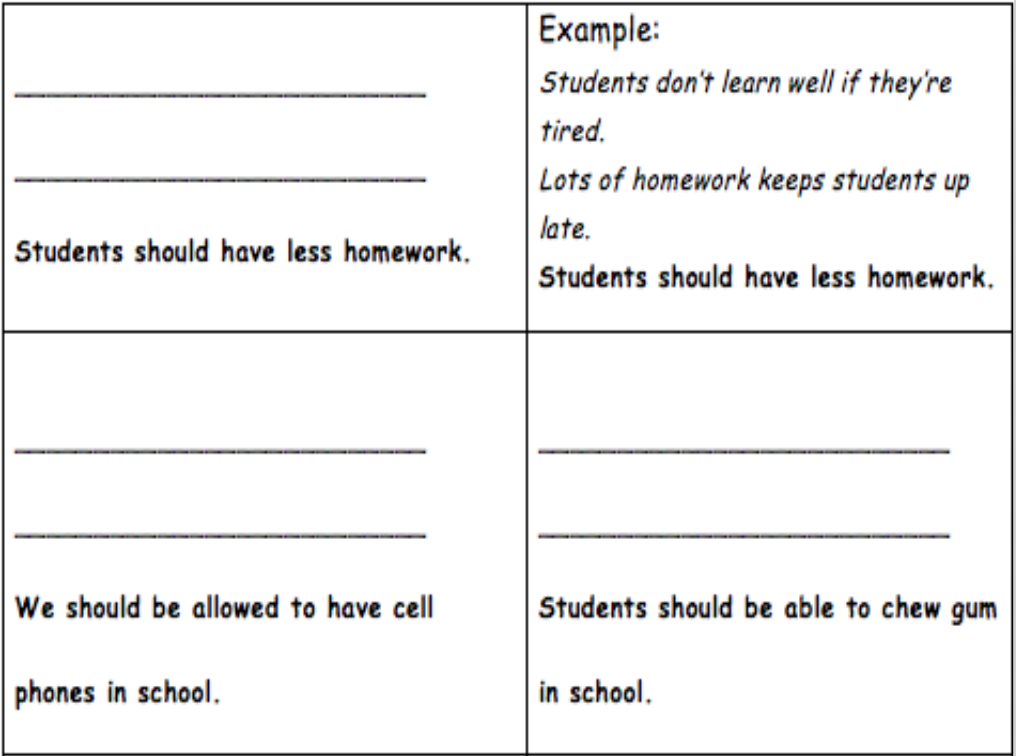
Screen Shot 2022-04-12 at 3.50.42 PMThe first one is a completed example. Students can fill in the others. Note: there is no one answer. One student could say, “Students can’t think well when they are fidgety. Recess gets rid of fidgety. So we need more recess.” Another might suggest, “Childhood obesity is a problem. Recess provides calorie burning activity. So we need more recess.” In some cases, a statement is offered and students need to come up with another statement and a conclusion. Again, there is no one answer. “The U.S. spends billions on defense. We have never been invaded. Therefore, we should keep spending.” Or, alternatively, “The U.S. spends billions on defense. Lots of that money is wasted. Therefore, we don’t need to spend that much.”
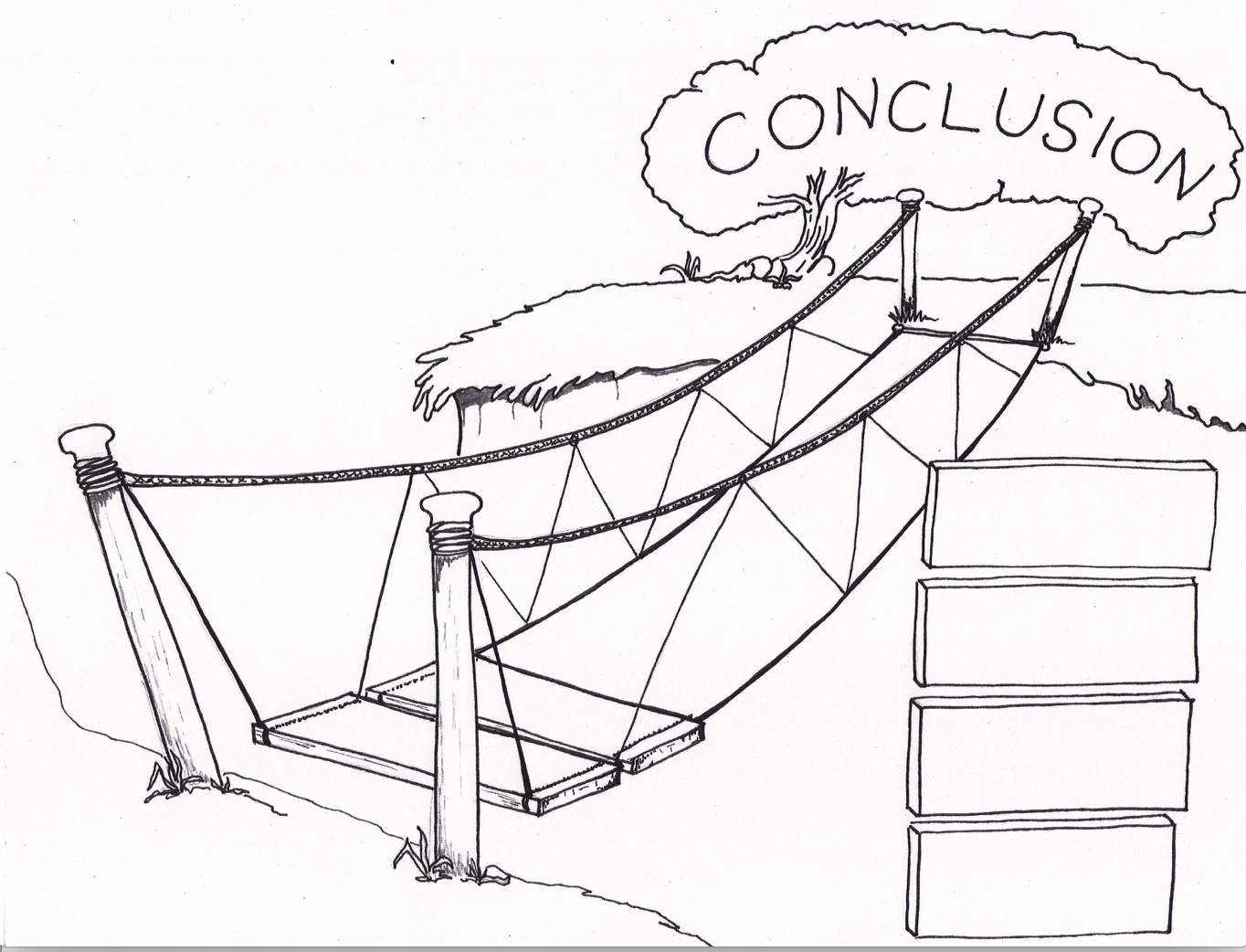
Some arguments need more than two statements to get us where we want to be. I use this example in the book:

            Schools should model healthy lifestyles for children.

            The French fries the cafeteria serves are full of fat and calories.

            Fat and calories contribute to overweight kids.

            Childhood obesity is a problem.

            Therefore, we should stop selling fries in our cafeteria.

We can use a graphic organizer such as the one below.

Screen Shot 2022-04-12 at 3.54.59 PM

Statements leading to a conclusion are represented by steps for us to get across the bridge. Put up some conclusions and let students practice building the bridge:

           The United States should ban handguns.

            Homework should be abolished.

            Plants are good for people.

            All squares are rectangles.

How many boards do you need?

The trick is to be sure that each board is needed. An example:

           The United States leads the world in handgun deaths.

            There are many kinds of hand guns.

            The high number of deaths is the result of how easy it is to get a handgun.

            If people couldn’t get handguns, they couldn’t kill someone with a handgun.

            The United States should ban handguns.

Which one of those statements does not help us get to the conclusion? Make sure you have students critique each other’s arguments checking to see if statements are missing and if all the statements are needed.

Arguments should be supported so we are tasked with teaching how to evaluate and use evidence. I ask teachers how they teach evidence and this is a typical response: “I tell students to add facts, evidence, etc.” Actually, facts are one type of evidence and I’m pretty sure “etc.” means “I don’t know anything else.” Do all of your students understand that there are types of evidence? How do you teach those? Let me guess: you have been given no materials and had no training about this, either.

Let’s go back to the football argument. We left off here:

Teacher: I see. Well that does add up, for sure. Those statements would lead me to your conclusion and make me think your conclusion is correct.

Here’s how that discussion should continue:

Teacher: Now we have an argument. But it seems some of your statements need support. “…causes kids to get concussions?” Do you have any evidence for that? “Concussions can cause big problems?” Do you have evidence for that?

I fear that most often when teachers ask for “evidence,” they mean “find me the place in the reading where it said that.” That is asking for the source, not for “evidence.” Another fear is that teachers give the impression that “quote” equals “evidence.” Too often, we say, “You need some evidence for that. Can you find the quote in the book where that was said?” I get really picky about imprecise language. Muddied vocabulary leads to muddied thinking. Students can get confused or, worse, misled.

I talk much more about evidence in the book, but alert readers will get a pretty good sense of the five types of evidence from the question the teacher asks:

Teacher: Can you give us a number of how many concussions occur? Do you have any facts about how concussions affect the brain? Can you tell us more about the example of your cousin and how he was affected? Is there a quote from some doctor who agrees with you? Can you make an analogy perhaps about how concussions are like hitting a car windshield in a car wreck?

That wasn’t so hard, was it? We change our language to be consistent and specific, and we teach a couple of mini-lessons just as we do with every other subject. We are well on the way to having arguments supported with evidence. A little upfront investment in teaching these skills will make so many things better in your class and beyond. Look back at the discussion that opened this article. With lessons about argument and evidence, discussions such as that are transformed.

Kids shouldn’t be allowed to play football.

Why would you say that? [Student version of “what statements lead to that conclusion?”]

 Kids get hurt playing football. [Nice! Student gives a statement of the argument!]

I play football and I didn’t get hurt. That’s ridiculous. [Direct challenge of the statement.]

You are one example only. Lots of articles talk about the number of concussions kids get.

Denver won the Super Bowl!

Where did that come from? What does that statement have to do with this argument?

Notice the improvement? The lessons we teach will spill over into every part of your class. I hope the lessons spill over into every part of our lives. I don’t know about you, but the election season drives me crazy.  Seems lots of candidates count on us not being able to recognize good thinking. Make sure your students don’t end up in that group!

Posted in Uncategorized | Leave a comment

Being nice is mean.

I had a problem with being too nice. Because I once had a job that involved phone sales, I knew how hard the job is and I had a soft spot for those trying to make it work. So when someone would call, I’d be nice. I had no intention of ever buying the product or going on the cruise or signing up for the club, but I’d listen and I’d say I was interested and I’d agree to talk again. I didn’t want to seem mean. After three or four calls, it became apparent that I was in fact NOT nice. I had wasted the time of callers and led them on. If I had been honest at the first call, it would have been better for them. So in a way, being “mean” would have been nice.

This came to mind as I watched some 3rd graders do a presentation. Students had completed projects, and as a culminating event, parents were invited to come see the projects and listen to each child’s three-minute talk. Students were told that one child would be given a prize for being the best speaker. One child really stood out. He was poised, had a clear voice, had lots of feeling, looked at every audience member, gestured well, had a nice pace—he was good. I talked to his dad afterward, and his dad told me all that he done to work with his son teaching him specific skills and showing him how to be a more effective speaker. The other children ranged from mediocre to poor. They shuffled and fidgeted. Some were mumbling, others too quiet. Most spoke in a monotone, some with an odd sing-song lilt that went up in the middle of a sentence and down at the end. Few had gestures. Some were too fast. Bottom line—they weren’t good.

Mean, right? Criticizing eight-year-old children? They all gave their best, didn’t they? Well, it turns out that the teacher wanted to be nice. While it was abundantly clear to everyone in the audience that one speaker stood out, the teacher wrapped up the evening by saying, “I know we said that we would select one speaker as the best, but I think all of the children were winners. All of them did a great job, didn’t they?” Aww, that’s nice. Except it isn’t.

Short term, the teacher was nice. Long term, damage was done. An opportunity was missed. The teacher effectively said something like “All speaking is equal” or “It doesn’t matter if one speaker is better than another” or, even worse, “Who cares how well you speak?” In other words, she missed a chance to say, “Wow. Did you notice how well Victor spoke? Did you see what 3rd graders can do? Let’s learn how to speak better!” She short-changed every student by accepting far less than what they are capable of and giving them the impression that poor speaking isn’t a problem.

The truth is that speaking is the number one language art. Professional and social success is more dependent on effective oral communication than on any other skill. It doesn’t matter what you know, it matters if you can communicate what you know, and the main form of adult communication? Verbal communication. Robbing students of the chance to become better speakers is definitely not nice. Failing to give them help to improve is flat out mean.

Look at a video clip of 4th graders. The first part is from a video a teacher posted on YouTube; the second part is from a school that taught specific lessons about speaking using ideas from Well Spoken: Teaching Speaking to All Students (see the book here.) The video is here: https://youtu.be/dbYTc9ZZQNc

Did you notice a difference in the speaking skill? The book report students aren’t perfect, but they are better. A lot better. So which teacher was nicer, the one who said, “Oh, that’s fine. I don’t expect more from you. Let’s put this up on YouTube for the world to see” or the teacher who said, “You aren’t ready to record yet. Let’s have some lessons on speaking first”?

We aren’t nice when we pretend that all results are equal, something we would never do with any other subject. (“Well, Erik, that answer is wrong because 1/4 plus 1/2 doesn’t equal 1/6, but so what? Everyone wins here!”) We don’t do students any favors by being nice when nice means failing to give them needed help. And we aren’t nice when we ignore a language art that has huge long-term value.

I don’t rudely hang up on callers now, but I do tell them the truth. We can let students know the truth, too. Not doing so is harmful. Visit pvlegs.com.

Posted in Uncategorized | Leave a comment

Three questions about Media Literacy at your school

How to Teach Listening in the Digital Age: Three Questions to Ask

When I began teaching a couple of decades ago, I read an article about how much television children watched. I was stunned by the numbers and wondered if my class was typical. I surveyed them. They were typical, watching an average of three and a half hours a day. I discovered that in spite of all the time they spent in front of the tube, they knew little about television. Sitcom structure, number of commercials per hour, persuasive techniques used in commercials—all of these were unknown to them. So, I developed a TV literacy unit.

As I was writing Teaching the Core Skills of Listening & Speaking (ASCD, 2014), I realized that the thinking behind that unit applies today. What are students listening to now? TV, yes, but a massive amount of other media in addition. Messages come on laptops, tablets, and smartphones. YouTube videos, podcasts, movies, webinars, flipped instruction, and more compete for their attention. How prepared are they to “evaluate content presented in diverse media,” to use the language of the Common Core State Standards and the Indiana Standards? No better prepared than they were to evaluate television, I’m afraid. That led me to design a media literacy unit, Listening in the Digital Age.  Let me ask some key questions here.

Who teaches students how to evaluate sound? For instance, teachers should point out that music affects the message. It is not difficult to find video clips with happy music (as the baby animals frolic in the water), dramatic music (as the storm approaches), or scary music (as the predator begins to sneak up on the unsuspecting prey). Students easily see that sound has a purpose. I watched a 4th grade teacher show students how to make an “About Me” podcast. She gave attention to how the tools worked but none to how to select the sound she required as part of the podcast. Many students randomly chose one of the tools pre-built, looping tracks—a poor idea, and one that often distracts listeners rather than engages them. Why not teach the soccer maniac how to add the World Cup theme?

Who teaches students how to evaluate images? It is easy to find images of New York City, for example, from Google Images. Ask students to select images that would make someone want to go to New York. Then have them select images that would make tourists stay away. Students see that images have power to create messages by themselves, and begin to understand that they can select images to support a point of view. A high school teacher I know has his students use their smartphone cameras to create photo essays: one essay making the school look terrible, one making it look great. Both are “true,” he points out, in spite of the opposing messages.

Who teaches students how to evaluate video? Find a video from Kid President. Ask students if they got the message, of course, but go beyond that. Why was the video shot in a locker room, on a football field, and in front of a chalkboard with football plays shown in Xs and Os? Why does the scene change so often? Why the camera angle looking up at Kid President with a beautiful sunset above him? Video techniques have a purpose behind them, and students can begin to see how scene and montage affect the message. Many of your students have made videos at home. Ask them to share appropriate ones with the class, and ask them about the construction.

These ideas are a beginning to help students bombarded by media. Make sure your school commits to giving students the tools needed to be critical listeners and viewers of all of that content.

Posted in Media Literacy | Leave a comment

Media Literacy & Speaking (from Channel One Blog)

(See the original post here.)

After two decades teaching, Erik Palmer has coached countless students through the basic steps of forming a good argument. Drawn to debate in high school, his fascination with spirited discourse propelled him from the debate stage to law school. Later, he moved into business and helped grow a commodities exchange firm. When he became a father, he needed a more family-friendly schedule. “I loved playing with my kids. As a single dad, I wanted to be on the same schedule as my boys and was drawn to teaching.”

Early on, Palmer decided to bring his love of presentation and debate into the classroom. He quickly realized that kids didn’t speak well and was surprised at the lack of materials to teach it. “The limited information on speaking well was focused on esoteric, hard to understand jargon like ‘elocution,’” Palmer said. So he created his own curriculum that became known as The Palmer Method.

His eleven-step process (shown below) covered the two phases of speaking: what you do before you open your mouth and what you do as you are speaking.

Public Speaking and Media Literacy

Erik’s method became popular within his district and at professional development conferences. After becoming known as the “guru” for this topic of teaching kids how to speak, he was asked to write a book about it.

When researching the book, he found the speaking and listening standards required integrating and evaluating diverse media and formats. “That was my lightbulb moment,” Palmer said. “Wait, kids will need to be media literate to do that!” Listening standards also required the ability to evaluate arguments and reasoning skills.

Restoring Civility in Debate

Maintaining civility through heated debate is tough, especially when parties are anonymous on social media and debates are limited to 140 characters. One teacher of gifted students in Mississippi reported becoming reticent to discuss politics in the classroom, after moderating fights among her students during last year’s presidential election. “We have a bad model right now with tweeting and public name calling,” Palmer said. But we can teach students “don’t attack the person, attack the idea.”

In his classes, Palmer always assigned a “public defender” during student discussion and debates. The public defender knew to stop conversations that became heated and say, “You need to rephrase.”

“Over time kids learned to express an idea passionately without ever having to attack another individual,” Palmer said.

Palmer Method

Building a talk (what to do before you begin speaking):

  • Audience. Understand the people you are talking to. “There are differences between a group in Manhattan, New York and a group in Manhattan, Kansas.”
  • Content. Include relevant material that connects with the audience.
  • Organization. Have a strong opening, good transitions and a powerful closing.
  • Appearance. Make sure you look your best for the group you’re speaking to.
  • Visual Aids. Incorporate graphics that support your overall message.

Performing a talk (what you do as you speak):

These steps were given the catchy acronym kids could remember “PV Legs.”

  • Poise. Appear calm and confident and get rid of odd tics.
  • Voice. Make sure every word is heard.
  • Life. Add feeling, passion and emotion to your voice.
  • Eye contact. Look at each member of the audience.
  • Gestures. Use hand motions, facial expressions, and body motions to enhance your words.
  • Speed. Pay attention to pace and adjust it during your talk.

(From Erik Palmer’s Well Spoken: Teaching Speaking to All Students)

How do you teach civil discourse in your class? Share your experience in the comments.  We’ve also gathered additional links and resources to help you make the most of Media Literacy Week.

Additional Resources:

Posted in Media Literacy, Speaking | Leave a comment