Media Literacy (from Channel One Blog)

(See the original post here.)

“I don’t like football, it’s bad. It causes concussions,” he said, his small brow furrowed with conviction.

“Okay. Why do you feel that way? Help me and the class understand.” The boy’s teacher, Erik Palmer, gently probed for the rationale behind his statement. The child looked up, shifting his weight uncomfortably, before sitting back down. “I’m not sure, Mr. Palmer. I just heard it.”

“Fake News” remains a hot topic underscoring media literacy as an essential part of civic understanding. In celebration of Media Literacy Week, Erik Palmer, media literacy expert and Houghton Mifflin Harcourt thought leader, shared his perspective after 20 years of teaching the topic in classrooms and to educators.

“Spouting conclusions, unfortunately, has become the norm in today’s political discourse. We need to teach kids to construct the points that led to the conclusions,” Palmer said. “What sticks in people’s minds is what’s available to them. Topic X is bad, they recall hearing it, but don’t remember where.” In order to bring the concept to life in the classroom, a difficult one for many adults to grasp, students need to understand, “that’s a conclusion. What statements led to that conclusion?”

How to Know Which Sources to Trust

“The default used to be ‘I believe’ and is shifting to ‘I don’t believe anything,’” Palmer said. “When our top elected officials describe news from our most credentialed media outlets as fake, all sources of information are undermined.”

This mistrust is the troubling byproduct of both the rhetoric around fake news, as well as the actual presence of false news reports pumped into the internet by disreputable sources. Although the overall impact on children’s beliefs is still unknown, the trust gap among adults is visible. According to a December 2016 Pew Research study, nearly one-in-three U.S. adults (32 percent) say they often see fake political news online. An earlier report (January 2016) from Pew showed trust in the media among Millennials is trending down. Just 27 percent of Millennials now say the media has a positive impact, compared with 26 percent of Gen-Xers and Silents and 23 percent of Boomers.

Media bias, also widely discussed, perhaps more so after the 2016 election is one that journalists are honor bound to take seriously. “Many people may not realize that reputable news organizations follow strict journalistic ethics and standards and they have a lot of checks and balances along the way,” said Angela Hunter, Executive Producer of Channel One News. “So when you compare a legacy news organization to a blog or some other less traditional news organization, it is helpful to understand the journalistic process and what goes into the report.”

Educators and media have stepped up to teach the fundamentals of analyzing every source and evaluating it for trustworthiness. For instance, “fake and bias are different things,” Palmer said. “You can show images of Donald Trump that make him look like a wonderful or a terrible person. Both images are true — the photos exist. Choosing one image over the other displays your bias.”

It takes a long time for kids to grasp subtleties on the continuum from fiction to fact across categories. Palmer suggested that, “a little bit of suspicion should be the new default. Let’s help kids move to ‘even if I believe most of what I see is true, let me check.’”

Standards for Media Literacy

Media literacy concepts are now baked into state and national standards across subjects, including the C3 Framework for Social Studies, which includes “making and supporting evidence-based claims and counter-claims” as a key component. They require that students demonstrate the ability to access, analyze and evaluate all media types, from movies and TV shows to news articles and YouTube clips. “Teaching students how to think, not what to think, is the goal of social studies educators,” said Geraldine Stevens, Product Marketing Director for HMH Social Studies. “In this way, skills are paramount. When students look at evidence — in all its modern forms — they analyze point of view, bias, context and authenticity. This is critical to successfully navigate today’s media-saturated society.”

How do you teach media literacy in your class? Share your experience in the comments. We’ve also gathered additional links and resources to help you make the most of Media Literacy Week.

Additional Resources:

Posted in Media Literacy | Leave a comment

Understand the audience!

What do these three articles have in common?

  • Amy Dinning (dinning@arris.com) wrote about networking. She said that if you want to be a successful networker, you should do something before attending an event: find out who will be there and do some research online to find out about the people you want to meet. TD Magazine 8/17
  • Phylise Banner (pbanner@insynctraining.com) wrote about content strategy and how to target content for a specific community. She suggested creating learner personas based on surveys or interviews with learners to find out their preferences, attitudes, motivations, and so on. TD Magazine 8/17
  • Howard Pitler (hpitler@gmail.com) wrote about six questions teachers should ask their students on the first day of school including “What are you passionate about?” “What is your greatest strength?” and “What characteristics do you want in a teacher?” http://inservice.ascd.org/6-questions-to-ask-your-students-on-day-one/

I found all of those articles as I was reading yesterday, and I realized that all of them are about what I call “Step One: Analyzing the Audience.”

Readers of Own Any Occasion know that there are two parts to being an impressive speaker: one, creating a good message and then two, delivering the message well. There is no point in speaking if you don’t have something worth saying. There is no point in having something worth saying if you can’t say it well. The three articles above all refer to an aspect of creating a message. Before speakers ever open their mouths, I wrote that there are five steps needed to take to make sure the talk will be well-received. The first step is to analyze the audience. I am surprised at how often speakers underestimate the importance of this. Indeed, some speakers never even think about it, yet all talks are doomed if the audience analysis isn’t done. All three of the articles are really telling readers the same thing: find out about the folks you’ll be talking to.

It is quite common for managers, trainers, teachers, and salespeople to have content they must cover. The employees/trainees/students/buyers must be told about the new procedures/safety regulations/sales promotion/whatever and so that’s that. The content is the content, and it must be presented. Pretty PowerPoint slides are made; another handout for the binder is created; an evaluation form with smiley face/frowny face is run off; and the text of the talk/lesson is prepared with all the important information. Then the thought is, “I covered it so I’m done.” Unfortunately, this forgets the most important people, the audience. Did the listeners get it? Was there an impact? You know that way too often the answer is “No.” So what went wrong? The speakers only thought about themselves as they prepared: what do I have to say? Big mistake.

All talks are for an audience. That audience may be one person, a few, or many, but the audience must be understood before any other preparation takes place. What do they know? What do they need to know? What do they want to know? What mood are they in? What are their interests? What filters/mind-sets do they have? (A baby-boomer with 28 years of experience “hears” messages differently than a Gen-Xer with 8 months of experience even though the words spoken were the same.) What will they be able to get out of the talk? All three articles feel the need to remind their readers about Step One: before a word is spoken out loud, it is critically important to know about the people being addressed. Implied is that once you know who they are, you must make adjustments to your talk.

  • Adjust your language. What level of vocabulary is appropriate?
  • Adjust your style. Should you be formal or informal?
  • Adjust your look. What will the listeners be expecting?
  • Adjust your content (Part A). Is it all necessary? (No.) What will the listeners be able to grasp right now?
  • Adjust your content (Part B). What can you add that connects you and your content to their lives?
  • Adjust your expectations. Realistically, will all listeners respond exactly as you hope?

Every talk is more effective if it is adapted to the audience. It may seem difficult to accept, but listeners are your number one concern, not your topic. Amy, Phylise, and Howard want us to know that.


Posted in Speaking | Leave a comment

Evaluating speaking (reprint from Middle Level Insider)

Middle Level Insider
March 2012

Evaluating Students’ Speaking Skills

Erik Palmer

No two people have the same perspective about what constitutes an effective speaker. So, how can teachers fairly assess student speaking skills as they prepare for the Common Core State Standards?

As I shared in January’s Insider, building a speech and performing a speech are separate activities. When we build a speech, we think about all the things we do before we ever open our mouths; when we perform a speech, we think about all the things we do while we are talking.

Understanding the distinction between building and performing is the foundation for creating effective rubrics to assess student speaking.

Too often, teachers combine disparate elements on their rubrics: “Content, volume, and pacing—20 points.” Or they combine multiple factors on one scoring line: “Spoke loudly, clearly, and slowly—10 points.” Did the student get a 6 because she was loud enough and clear enough but spoke too fast? Was she a little off on each of the three things? She has no idea what to work on before the next presentation.

Separate “building a speech” elements from “performing a speech” elements on your rubric. On the top half of the score sheet, score content, organization, and visual aids; on the bottom half, score poise, voice, life, eye contact, gestures, and speed. Give both parts equal weight.

Get Focused
You do not need to use the same rubric for every oral presentation. For example, I use a six-trait writing rubric for evaluating student writing, but I do not score all traits on all assignments. I might give a 10-minute prompt and say, “Our focus today is on word choice. Use powerful words and well-chosen adjectives.” Next time, I might focus on content and detail.

Similarly, you can tell students that in today’s presentation, we will focus on eye contact and look at classmates as we talk. Or, for the next oral book report, we will focus on organization and on gestures.

Be Consistent
Always use the same terms when you talk about performance. At the beginning of the year, I introduce PVLEGS as the six traits of all performances: poise, voice, life, eye contact, gestures, and speed. I may not score each element each time, but I never vary the language. “Gestures” never becomes “body language” or “movement.”

Use simple language. “Elocution,” “presence,” and “fluid body language” are not student-friendly words. “Speak each word clearly,” “be poised,” and “use hand, face, and body gestures” are more accessible terms.

Develop a consistent, school-wide language. When students move from grade to grade or from class to class, they should be able to expect the same grading system. Don’t have one teacher score “articulation and posture,” another “elocution and loudness,” another “hold head up and enunciate.”

Involve the Students
A speech is for an audience, and the audience’s opinion must be part of the grade. All listeners should have rubrics to score their classmates’ speeches. No, it doesn’t become a popularity contest. Students are good evaluators and they know poise when they see it; they know if the speech covered the required content.

Involving the students also makes them attentive, critical listeners—which is important when you address the listening part of that Common Core State Standards Speaking and Listening standard.


Erik Palmer, a former teacher, is a consultant, AMLE Conference presenter, and author of the book Well Spoken: Teaching Speaking

Posted in Speaking | Leave a comment

Don’t flip your class…yet

Evidence that you are getting old:

  • You watch the Grammy’s and don’t know many of the performers.
  • You say, “These students used to be so much better.”
  • You think the flipped classroom is a big deal.

Let me focus on just the last one.  Older folks are making the decisions in your district.  They are easily amazed by all the new-fangled gadgets.  Interactive whiteboards and response systems!  Wow!  If you touch the board, stuff happens!!  If you tap “A” on the little thingy, the answer shows up on the board!!  We gotta have that!!  Will the teachers use it?  Does it improve scores?  Will the glitz wear off leaving you with a “the emperor has no clothes” sort of thought?  I don’t know, I just know it is really cool like the stuff I saw on Star Trek as a kid!  And so your building has lots of seriously expensive and seriously underused tech stuff.

Now comes the flipped class idea.  Wow!  You can use this stuff to make a video?  Then you can post it on that internet place?  And kids have things they can watch it with?  That is so amazing!!  Why I bet these kids today will just love that sort of thing.  They loves their computers and I just know they will love watching us on those little screens!

The debate about the value of flipped classrooms is raging.  Does it just reinforce ‘the sage on the stage’?  Do students do their video-watching homework?  Is it right for all kids?  Does it put students in charge of their own learning?  And so on.  I won’t get into the debate here.  I will just say this: you aren’t that good.

That is a rough statement, perhaps even rude.  But think about this: actors get paid well for a reason.  They can do something that few people can do—they can be very impressive on a screen.  Very, very few of us can command attention in a digital format. All media (radio, TV, podcast, webinar) require much more than in-person communication requires.  When you digitize a live presentation, the nature of the small screen/small speaker makes a great presentation seem good; a good presentation seem blah; a blah presentation seem dreadfully boring.  Who in your building has the chops to pull this off?  Way less than you think.  One out of twenty?  One out of fifty?

And think about this: editors and special effects and foley artists and soundtrack people get paid well for a reason.  They can do things that few people can do—they can enhance a presentation.  No one wants to watch a teacher talk for an hour.  No one wants to listen to ten minutes of looped jingles you added from GarageBand as a soundtrack.  No one wants to watch you write on a dry erase board or watch a Camtasia screen capture.  It is cruel to ask students to watch some of the things being created, and if many teachers switch to flipped classrooms, forcing our kids to go home and spend an entire evening watching the junk we create will be beyond the bounds of reasonable.  YOU go watch an hour of some the stuff out there and see how YOU like it.

I started out teaching students how to be better oral communicators.  Lately, I have been getting calls to work with adults, also.  Schools and universities are contacting me not to show the faculty how to teach oral communication to students, but to show the faculty how to be better communicators themselves.   These institutions realize that to be effective educators, we all need to be more effective speakers.  They realize that in an era where digital media showcase oral communication skills, we need to seriously improve those skills before we attempt to use the new communication tools available.

I suspect the buzz about the flipped classroom will wear off and the fad will fade.  Maybe I am wrong.  I know I am not wrong about this, though: Don’t even think of heading down that road unless you first absolutely master oral communication.  Yes, this stuff is all new and wow-inspiring, but to pull it off, your speaking needs to be wow-inspiring also.  Start there.  www.pvlegs.com

Posted in Uncategorized | Leave a comment

Communication in the 21st Century (originally published in HMH Charter School Newsletter)

Charter School Newsletter August 2015

Communication in the 21st Century
By Erik Palmer–Educational Consultant, Author, and Speaker

Communication in the 1st century. No, that’s not a typo, though to be more accurate, I should say 1st century B.C. What was the most important skill to develop for effective communication? Oratory, the art of speaking. In ancient Greece and Rome, oral communication skills were highly valued and those who spoke well ruled. Most of us recognize the name Cicero. He was in our history texts, and, twenty-two hundred years after his death, he is still remembered. Why? He was a great speaker in an era when oral communication was valued.

Fast forward to the 21st century. What is the most important skill to develop for effective communication? Once again, the art of speaking. Skype. FaceTime. Webinars. Podcasts. Video. Video conferences. Google Hangouts. We can easily get caught up in the “Wow! These tools are amazing!” and fail to realize that all these tools (and many others) have at their core oral communication. They are designed to showcase speaking. Verbal communication is on display in the 21st century like never before. Cicero spoke to small audiences around Rome. It is common for speakers today to be digitally addressing potentially huge audiences around the world. Today, people who are well spoken will be more successful professionally and socially than people who aren’t well spoken.

Unfortunately, schools have largely ignored oral communication. After some other unit, we will make students give a speech, but we do not have specific lessons to prepare them to do that speech well. No wonder people fear public speaking—they have never been taught how to do it. You’ve noticed. When you look at students speaking, you have realized that they do not speak well. Listeners are not engaged. Poetry recitations are unimpressive. Book reports do not inspire other students to go get the book. Twenty four hours later, students cannot tell you anything about the historical figures presented in the 3–5 minute talk required at the end of biography research unit. The speaking we make students do isn’t working for the speakers who aren’t improving or for the audiences who are not getting anything out of the talks. What do we need to do?

A short article cannot solve the problems, but I think I can point you in the right direction.

  • As a school, commit to valuing speaking. Develop a scope and sequence for speaking skills. Whenever someone says “reading and writing,” stop them and say, “You mean reading, writing, and speaking.”
  • Just as you have workshops about bully-proofing, equity training, RTI, and more, commit to providing workshops about how to develop verbal skills.
  • Find materials that show teachers how to teach speaking skills. They are hard to find. I wrote Well Spoken: Teaching Speaking to All Students to fill this void. Houghton Mifflin Harcourt’s Collections has self-guided student tutorials guiding students to effective oral communication. Avoid materials that include speaking as an afterthought—a book about writing or reading strategies with a couple of oral activities mentioned is not going to get the job done.
  • Develop a school-wide consistent language. Odds are that every teacher in your school has a unique score sheet or rubric. One might score “elocution, eye contact, inflection;” another “enunciation, gestures, vocal modulation;” another “loudly, clearly, slowly;” and so on. We make mastery difficult if we shift language and expectations from class to class, grade to grade. I offer a framework in Well Spoken that can be a model for your school.
  • Use digital tools. Every Mac computer has Photo Booth built in. PCs all have digital cameras built in. Record students and use those as rough drafts giving students the ability to see themselves before presentation day. Use http://www.vocaroo.com to have students record themselves. Provide feedback. If students have cell phones, have them video their talks and share some for instructional purposes.

Bit by bit, educators are coming around to the belief that we cannot continue to shortchange the number one language art. I started out by saying that speaking well is the most important communication skill for the 21st century, and I guarantee that your students will be forever grateful to you if you give them an effective voice. They may not achieve the fame of Cicero, but they will be prepared for the communication demands of their futures.

Erik Palmer is a veteran teacher, education consultant, and author of Teaching the Core Skills of Listening & Speaking, Well Spoken: Teaching Speaking to All Students, Researching in a Digital World, and Digitally Speaking: How to Improve Student Presentations with Technology. His areas of focus include improving oral communication, promoting technology in classroom presentations, and updating instruction through the use of digital tools. He is also a program consultant of Houghton Mifflin Harcourt™ Collections. He holds a bachelor’s degree from Oberlin College and a master’s degree in curriculum and instruction from the University of Colorado.

Posted in Uncategorized | Leave a comment

Speaking & Listening Article from MiddleWeb

middleweb.com

Speaking & Listening Are Core Skills Today

by MiddleWeb · 11/03/2015

Erik-Palmer-140By Erik Palmer

Pop quiz! Please fill in the blanks:

The primary responsibility of English and/or language arts teachers is to teach _____________ and _____________.

Did you think “reading” and “writing?” The overwhelming majority of educators do. Those two words are inextricably linked in our minds.

Look at session descriptions at educational conferences. Many are about “reading and writing” strategies. Look at educational materials being sold. Most want to help you with “reading and writing.” Follow Twitter chats online. Often the tweets are about cool things to use to teach “reading and writing.” We might as well just make one new word: readinganwriting.

Here is the second question of the quiz:

Adults spend a large amount of their waking hours communicating. Reading and writing make up _________percent of that time.

If you answered twenty-five percent, you are correct. Yes, only one-fourth of our communication time. That might seem surprising to teachers so focused on readinganwriting, but few people find the percentage hard to believe once they think about their typical day.

Verbal-Number1

Sure, we spend some time with emails, online news, and print, but we spend way more time engaged in conversation. Three times more, in fact. Listening and speaking make up the other seventy-five percent of adult communication time.

We haven’t taken speaking & listening skills seriously

I came into education after a career in business. I ran a commodity brokerage firm, and I had a seat on the floor of a commodity exchange. Those are verbal businesses so I was perhaps more tuned in to oral communication than most teachers.

I noticed right away that my fifth and sixth graders spoke poorly. My teammates had an attitude of “Oh well, that’s just how kids speak.” How they do speak, however, is vastly different from how they can speak. And we would never say, “That’s just how kids do math.” Or read, or create a pot in art class. All these are skills that require teacher time and student practice.

the-same-boat

I suggested to my teammates that after years of weekly share time, book reports, sharing solutions at the board, poetry recitations, and all the other talking students do in elementary school, to have students speak so poorly reflected badly on us as teachers. Clearly, we had been inattentive to the most important language art. Students had been shortchanged. Our expectations of them were way too low.

I asked for the materials we had for teaching speaking. We had a spelling program, a grammar program, a science program, a math program, a Daily Oral Language program, a drug education program, novel sets, and basal readers. We had zero materials about how to teach speaking. (Did I mention that speaking is not just for English class anymore?)

Not-just-ELA

I started searching for resources to teach students how to be better oral communicators, and I discovered that there weren’t any. For example, the catalog of the National Council of Teachers of English had over 200 books listed yet included no books about how to teach speaking. (That’s still true today.) I was shocked and disappointed.

The solution? Create my own materials. I came up with a logical, practical framework for teaching speaking. I developed mini-lessons to teach the skills set out in the framework. I invented rubrics for evaluating speaking. You can get a sense of the framework and sample a couple of activities in this video:

Effective-Communication-Erik-PalmerClick to watch Erik’s animated video

The result? My students began to speak well. An administrator in the building asked me to go to the school her sons attended to show that staff how to teach speaking. She wanted her children to be well spoken and gave me my first consulting job. I was invited to teach a workshop for a district’s summer teacher training.

Someone there suggested that I write a book. Stenhouse Publishers had the foresight to publish it: Well Spoken: Teaching Speaking to All Students. A second book, Digitally Speaking, followed. ASCD invited me to write Teaching the Core Skills of Listening & Speaking. Houghton Mifflin Harcourt asked me to be a program consultant for them.

s&l-skill-sets

I seem to have struck a chord

First, I think I created awareness. When teachers really look closely at students speaking—whether one-on-one, in a small group, or in a class presentation—they are quick to recognize that the students need help. We have been focused on other things (readinganwriting!) and we tolerated mediocre to poor oral communication.

Second, I think I filled a gap in teacher preparation. Teacher preparation programs and district workshops never show educators how to teach speaking. When speaking standards started showing up, teachers were not prepared to teach them. I ask teachers at workshops to tell me exactly what it takes to be a great speaker, and most are not sure.

Finally, I think I emphasized a skill coming back into fashion. Many digital communication tools exist—for podcasting, video creation, audio recording, producing webinars, and allowing face-to-face online communication. All of those tools showcase speaking, and many of us are beginning to realize the need to raise the bar for oral communication skills.

oral-skills-key-to-21stC-comm

Simply put, we have shortchanged the most important language arts. That has to change. Our students can do better, and they deserve better. They obviously aren’t successful oral communicators now, and that won’t change unless we specifically teach them how to be well spoken. I’d suggest we start now.

(Editor’s note: Thanks to Dave Stuart Jr. for his post tracking down a direct link to Erik’s excellent animated video, which makes a compelling argument for speaking & listening instruction. Stuart’s “sparknotes” are a good read. Illustrations used in this post are from “Effective Communication with Erik Palmer.”)

Erik-ASCD-cvrErik Palmer (@erik_palmer) is a professional speaker and educational consultant from Denver, Colorado. He spent 21 years in the classroom in the Cherry Creek School District in Englewood, CO, primarily as an English teacher but also as a teacher of math, science, and civics. Erik is the author of Teaching the Core Skills of Listening and Speaking (ASCD 2014) and other books, and a program consultant for Houghton Mifflin Harcourt’s English Language Arts program, Collections.

Posted in Speaking | Leave a comment

Something’s gotta go.

The situation: a Colorado school where I was going to conduct a workshop;  a class still in session in the room I was going to be using; students with crayons making drawings of dirt. I know you may be thinking: Dirt?  Why would someone have kids draw a picture of dirt?  How is that important?  Those were exactly my thoughts when I found out that a teacher was having kids draw pictures of dirt.

I have been doing some work lately with districts concerned about speaking and listening.  That work involves teaching active listening, media literacy, internet literacy, argument & reasoning, and strategies that can be used to develop effective oral communication in all of its forms.  Part of the training includes how to update instruction with Web 2.0 tools that contribute to developing speaking and listening skills.  Part of the training asks teachers to critically think about the value of some of their old favorite units.

The dirt drawing?  It was part of a unit on Colorado State Symbols.   Seems this teacher spent two weeks a year on the unit and had been doing so for 16 years.  Each student made a drawing of each state symbol and at the end, stapled them all into a “book.”   Colorado has a lot of state symbols: a state rock, a state gem, a state sport, a state mineral, a state grass, a state bird, two state songs, and on and on.  The legislature has thought of everything.  And of course, they have a state dirt.  I am not making that up.  The teacher considered it a great speaking lesson because at the end, they got up and shared their books even though they all contained the exact same things.

I disagreed.  I suggested throwing out the entire unit.  If anyone ever needed to know the state rock, it could be searched on Google and in 0.038 seconds the answer would be revealed.  But no one will ever ask.  And it is not a legitimate speaking activity.  Having kids talk at the end of some unit is not the same as teaching effective communication skills.  This caused some upset.

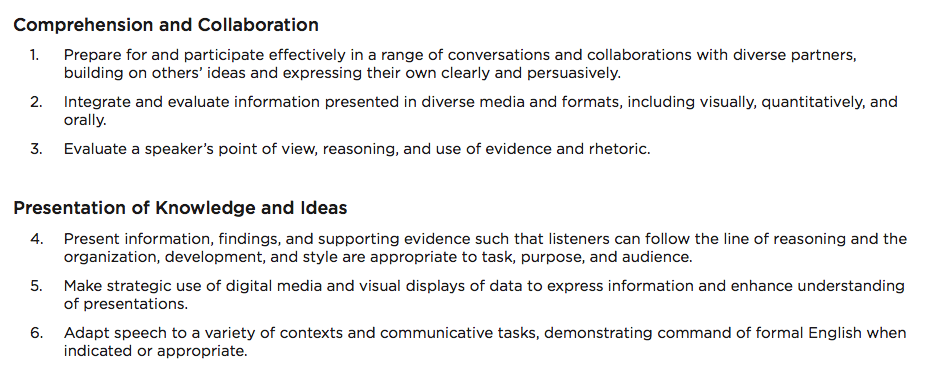
Have you seen the Common Core Listening & Speaking Standards?

Image

If the CCSS go away and get replaced by some new initiative, none of these will lose their value.

  • Shouldn’t students be able to converse and collaborate?  Do you believe they can do without direct instruction?
  • Shouldn’t students be able to make sense of all the media input they get?  Do you have a unit on persuasive techniques, using images and sound to manipulate, reading and evaluating Internet pages?
  • Do you specifically teach reasoning errors, how to build a logical argument, how to support premises with evidence?
  • Do you have a lesson about how to gesture effectively?  Do you have a lesson about how to adjust speed for effect?  Do you have ANY specific lessons about the speaking skills you score on your rubric?
  • Have you taught students how to build an effective digital presentation?  How to design even something as mundane as a PowerPoint slide so it is more than words being read at the audience?  How to set camera angles for the YouTube video or podcast?
  • What lesson do you have about how to adjust speech to the audience and purpose?

Think like a parent.  Do you want your child copying Colorado symbols or learning how to evaluate a website?  Do you want your child getting yet another haiku unit or getting a unit on effective oral communication? (One of my boys had a haiku unit in six different years of schools but he never had even one unit on speaking in all of his schooling.)

We have to reexamine what we are teaching.  We have to be brutally honest with ourselves and with our teammates.   Certainly many of us are set in our ways, but some of what we teach is junk.  It is difficult to clean house and taking out the trash is a dirty business, but our students deserve more than dirt.

Posted in Uncategorized | Leave a comment

Lip Service (originally published by ASCD)

Teaching Presentation Skills: No More Lip Service

The new, higher value placed on teachers and teaching makes it more important than ever to invest in the power of great instruction and learn how to leverage it in classrooms and school districts. This summer, we invite educators to make that investment at ASCD’s Conference on Teaching Excellence. The Conference features more than 150 sessions for educators of all levels and will be held June 28–30, 2013, in National Harbor, Md. Below, we hear from education consultant Erik Palmer, whose sessions “Common Core Speaking and Listening: Preparing Students to Exceed the PARCC and SBAC Assessments” and “Digitally Speaking: How to Improve Student Presentations with Technology” will be held on Friday, June 28. Register for the conference here.

“I just watched our seniors present their capstone projects. They were unimpressive presentations, to say the least. Frankly, I’m worried that they make our school look bad.”

Those were the words of the president of a small university when he called to ask me to work with his faculty. The seniors had to present their final project to classmates as well as a broader audience, including community members. The content didn’t worry the president, but the lack of effective oral communication skills certainly did. Unlike many administrators and educators, he was able to take an objective look at student performance. Among the things valued in the university’s mission statement were presentation skills, but he realized that they were only paying lip service to that goal.

How is it possible that students in their 17th year of schooling can be so unimpressive when asked to speak? In kindergarten they talked at circle time; in 1st grade they shared at show & tell; in 2nd and 3rd grade they did book shares; in 5th grade they presented their biome dioramas; in 7th grade they participated in poetry café; in 8th grade they did mock trials; in high school they presented lab reports, research results, biography projects, DECA projects. In other words, at every grade level, students were forced to speak—sometimes formally, most often informally, but they had to say something. Sometimes teachers even gave comments after the students finished. So why didn’t students master oral communication?

Here is the answer: assigning speeches does not equal teaching speaking. If we were as honest as that university professor, we would realize that we accept mediocre speaking, and we only pay lip service to the importance of oral language. We do not specifically and systematically teach speaking skills.

Every school at every level claims to value oral communication and presentation skills. Some schools say they teach presentation skills. But do they? Is there a consistent schoolwide language and coherent method for understanding the components of effective verbal communication? Are there series of lessons that follow a logical, scaffolded pattern leading to good speaking in all of its forms? Does every teacher have the same rubric with the same language so that students know their speaking will matter and be consistently evaluated in every subject at every grade level? I haven’t found one school that can answer yes to all of those questions. Lip service, indeed. We don’t develop effective communication skills by making students get up in front of the class every once in a while and then handing them a score sheet with various descriptors.

A 10th grade teacher assigns a five-paragraph persuasive essay. That is fair because the 9th grade teacher had lessons about thesis statements; the 8th grade teacher had lessons about supporting statements with reasons and evidence; the 7th grade teacher taught word choice and powerful verbs; the 6th grade teacher taught topic sentences and effective endings; the 5th grade teacher taught about sentence fragments and run-ons; and every teacher taught spelling, capitalization, punctuation, and all the other basic lessons that build writing skills.

Change the assignment. Make it a five-minute speech instead. At what grade level were descriptive or emphatic hand gestures introduced and practice assignments given enabling students to master the skill? When were facial gestures introduced? Body gestures? What assignments were given to help students develop those skills? At what grade level were students introduced to speeding up or slowing down for dramatic effect and given small practice speeches about exciting events so that they could become competent shifting speeds when required? At what grade level. . . . Well, you get the idea. As I said, teachers probably made some sort of comment at some point about some aspect of speaking, but a series of random comments over the years is not a commitment to presentation skills. Lip service is not an oral language curriculum.

When we consider how many digital tools are designed to put oral communication on display, it becomes more critical to develop speaking skills. Podcasts, videos, video conferences, webinars, Skype, online narrated slideshows—effective speaking is in high demand.

The good news: oral communication can be taught, students can do much better than we currently accept, and speaking-skill lessons are easy to add because our classes are already verbal. All it takes is a commitment to learn how to teach speaking and how to use the tools available today to develop competent communicators. Enough lip service! Let’s get serious.

Posted in Uncategorized | Leave a comment

Voices from the Middle article: Listening and Speaking Demystified

Voices from the Middle, Volume 22 Number 1, September 2014

The Forgotten Language Arts:
Addressing Listening & Speaking

Erik Palmer

TEACHING THE COMMON CORE

The Forgotten Language Arts: Addressing Listening & Speaking

ABSTRACT

Common Core State Standards include listening and speaking standards yet those receive little attention. All teachers need to become aware of the requirements of the standards and need to specifically teach students the skills needed to master the standards. There is much more to the standards than the words “listening” and “speaking” suggest. Students must learn how to collaborate with diverse partners, evaluate information from diverse media and in diverse formats, evaluate speakers’ rhetoric, construct and deliver presentations, incorporate multimedia in talks, and adapt speech to varied contexts. This article introduces the standards and suggests approaches to mastering them.

TEACHING THE COMMON CORE

The Forgotten Language Arts: Addressing Listening & Speaking

Common Core State Standards (CCSS; National Governors Association Center for Best Practices & Council of Chief State School Officers, 2010) have been the major topic of discussion for some time now. English teachers are probably aware that ELA Standards have led us to examine the fiction/nonfiction percentages in our classes, the text complexity of our materials, and the meaning of close reading. Most teachers, however, still seem to be unaware of the listening and speaking part of the Standards. Test yourself:

  1. How many listening and speaking standards are there?
  2. What is the category name given to the three “listening” standards?
  3. What is the category name used for the three “speaking” standards? (Question one answer revealed! Six!)
  4. What is the general idea of each of the six standards?

Don’t panic if you missed some (or all). The odds are overwhelming that your school has not focused on these. Perhaps they have never been mentioned. You never had a workshop or inservice presentation about them. You most likely have no materials on hand about how to address them. Even materials that offer help with Common Core Standards overlook listening and speaking. For example, there are four ELA Standards (reading, writing, speaking & listening, language), so you might expect a book such as Pathways to the Common Core (Calkins, Lehrenworth, Lehman, 2012) to spend a quarter of its pages on each topic. In fact, the speaking and listening section is less than 5% of the book. Shortchanging these Standards is common.

Do panic if you don’t remedy these situations. Students cannot master the Common Core Standards without mastering these specific Standards. And for those of you in areas where Common Core Standards are losing favor, know that students cannot be prepared for life without mastering these Standards. If the Common Core movement goes away tomorrow, these six parts of that movement must remain.

I am afraid that when teachers become aware that listening and speaking Standards exist, they will think, “Oh, I’ve got those covered. I don’t have problems with classroom management and my students do lots of talking in class.” We confuse sitting still and being quiet with effective listening; we mistake having the ability to utter words with effective oral communication. I make the argument in Teaching the Core Skills of Listening and Speaking (Palmer, 2014) that there is much more to the Standards than the words “listening” and “speaking” suggest. Let me share a part of that here.

To answer the second question above, the “listening” Standards actually fall under the label “Comprehension and Collaboration.” As you look at the three Standards under this umbrella, two points will stand out: there is not one of these that we wouldn’t want for all students; there is much more involved than the word “listening” would suggest.

CCSS.ELA-Literacy.CCRA.SL.1: Prepare for and participate effectively in a range of conversations and collaborations with diverse partners, building on others’ ideas and expressing their own clearly and persuasively.

CCSS.ELA-Literacy.CCRA.SL.2: Integrate and evaluate information presented in diverse media and formats, including visually, quantitatively, and orally.

CCSS.ELA-Literacy.CCRA.SL.3: Evaluate a speaker’s point of view, reasoning, and use of evidence and rhetoric. (CCSS, 2014)

To meet these Standards, serious instruction is required. Standard 2, for instance, requires us to teach sound (how it can be used to manipulate us and/or enhance presentations); to teach images (the importance of image selection and how images convey story); to teach video (the reasons for scene selection, camera angle, montage, and so on). We probably underuse diverse media in our classrooms. We definitely fail to teach all students how to analyze the construction of multimedia messages and how that construction contributes to the underlying message.

Standard 3 requires us to teach reasoning (e.g., understanding ad hominem attacks, hasty generalizations, cause/correlation errors), logic (e.g., looking for premises that will lead to the conclusion), and rhetorical devices (e.g., hyperbole, repetition, persuasive techniques). These are teachable, yet you will find few English teachers with persuasive technique units or logic lessons. Students cannot figure these things out on their own, just as they cannot figure out metaphors without direct, specific instruction. Brilliant use of metaphors, good reasoning, and the ability to analyze images do not spontaneously occur. They all require specific instruction. Why, then, do we only teach about metaphors? How can students evaluate diverse formats without specific media literacy lessons?

It is not difficult to teach these new skills. For example, here’s a simple lesson on the power of images: Give one team of students a camera and instruct them to make the school look terrible today; give another team a camera and instruct them to make the school look great today. Both will succeed. One team will photograph trash that missed the wastebasket, a torn poster hanging on the wall, and so on; the other, smiling students, the newest computer in the library. It is quickly obvious that images have power to tell stories and that image selection is important. Both groups told the “truth,” yet the messages are quite different. Students will now be critical of the images they are exposed to in the information they receive. Now we are on the way to mastering Standard 2. As I noted, it is not difficult to teach the skills. It is very difficult, however, to open our minds to the reality that haiku may have to move aside to allow instruction about new literacies.

My passion has always been oral communication—giving students the ability to communicate well in any situation. I fear that if teachers think of speaking skills at all, they think of Public Speaking, that one big presentation. The Standards correctly value developing oral communication skills for all verbal communication situations including, but not limited to, formal presentations.

Look at the three Anchor Standards for “speaking” or, more correctly, “Presentation of Knowledge and Ideas”:

CCSS.ELA-Literacy.CCRA.SL.4: Present information, findings, and supporting evidence such that listeners can follow the line of reasoning, and the organization, development, and style are appropriate to task, purpose, and audience.

CCSS.ELA-Literacy.CCRA.SL.5: Make strategic use of digital media and visual displays of data to express information and enhance understanding of presentations.

CCSS.ELA-Literacy.CCRA.SL.6: Adapt speech to a variety of contexts and communicative tasks, demonstrating command of formal English when indicated or appropriate. (CCSS, 2014)

In a recent issue of Language Arts, a teacher described a project she did with her class. She included a grid where she checked off the many Standards met by the project. Because she had students present results to the class with a PowerPoint at the project’s end, she checked off all three speaking Standards and said, “Students met many of the speaking and listening Standards when they presented their findings to their peers” (Grindon, 2014).

In fact, it is possible that they met none of them. There was no evidence that any student spoke well, as Standard 4 would require. Standard 5 requires incorporating multimedia, audio, and video. Bullet points on a PowerPoint slide do not qualify. Standard 6 requires the ability to adapt speech to a variety of audiences. How does talking one time to a group of peers demonstrate that ability? Additionally, this teacher made a mistake almost all teachers make: failing to understand that assigning a speaking activity is not the same as teaching students how to do that activity well.

Imagine this scenario: a teacher is asked how he teaches writing. He replies, “At the end of some reading assignments, I tell kids to write for five minutes.” You ask him if ever teaches about punctuation, capitalization, sentence structure, or word choice, and he says, “Not exactly. I put some of those terms on the rubric, but I don’t have any particular lessons on them. I guess I think the kids will just figure out how to be a good writer somehow. They wrote for five minutes so I checked off all of the writing standards.” You would be appalled and rightly so. Commonly, though, teachers have students talk as an afterthought to some assignment, yet offer no lessons on the skills they assess. Look at the score sheets that you use in your class for speaking activities. Can you point to specific instruction you gave to students for each of the criteria? If you score “presence,” can you tell us exactly how you taught that? How about “body language”? When did you teach that?

Standard 4 requires students to construct a speech and to deliver it. (The expectations for delivery are quite low, as you will discover when you look at grade-level Standards.) Certainly, we see a tie-in with writing instruction (content, organization, voice), but it is important to realize that an effective oral communication is more than a good essay muttered aloud.

Standard 5 will stretch us. Very few teachers require video and audio enhancements in talks, and almost none of us had instruction about how to create videos, let alone how to teach those things. Camera angles, editing, adding sound? Teaching students how to incorporate media into presentations will be difficult. Suggestion: Use your students as a resource. Many students have been creating multimedia presentations on their own and are proficient with tools teachers are not aware of. Let students lead the way and then offer them guidance about matching style to substance.

Standard 6 expands our ideas about “acceptable” speech by forcing us to recognize that effective talks are adapted to the audience. English teachers always emphasize good grammar, but effective communication can occur without it.

Again, these are teachable skills. For example, to teach Standard 6, start with a discussion. Ask students if they speak differently to grandparents than to friends. What is different? Why? Point out that intuitively, we adjust speech. Then, offer a small assignment. Have students tell about something that happened at school in three different ways: as you would tell it to peers outside of school; as you would tell it to grandma; and as you would tell it to a newsperson interviewing you for the nightly news. Language will be different, formality levels will be different. Finally, adjust audiences during the year. Assign a presentation to be given to the class; bring in parents for some talk; make an instructional video to post on YouTube. For each, explicitly discuss the adaptations needed to be effective in the situation. I know I am on thin ice when I seem to attack haiku, but again I suggest that it may need to be de-emphasized to make room for these important skills.

We work hard to improve every child’s ability to read and to write. We must commit to working equally hard to improve every child’s ability to work well with others, to evaluate the diverse messages received, to create an engaging presentation, and to speak well in all situations. These are crucial skills. Common Core Standards give us a push, but concern for our students’ future should provide the motivation.

References

Calkins, L., Ehrenworth, M., & Lehman, C. (2012). Pathways to the common core. Portsmouth, NH: Heinemann.

Grindon, K. (2014). Advocacy at the core: Inquiry and empowerment in the time of common core state standards. Language Arts, 91, 251–266.

National Association of Colleges and Employers. (2012, October). Job outlook 2013. Bethlehem, PA: Author.

National Governors Association Center for Best Practices & Council of Chief State School Officers. (2010). Common core state standards for English language arts and literacy in history/social studies, science, and technical subjects. Washington, DC: Author. Retrieved from http://www.corestandards.org/ela-literacy.

Palmer, E. (2014). Teaching the core skills of listening & speaking. Alexandria, VA: ASCD.

Palmer, E. (2011). Well spoken: Teaching speaking to all students. Portland, ME: Stenhouse.

Posted in Speaking | 1 Comment